 |
| click the image to enlarge and read |

Monday, December 05, 2022
NOW is time to properly enshrine privacy and the subsumed right to reproductive freedom / body autonomy into Minnesota's Constitution. Such a step should definitively forestall a rogue judge from holding abortion unconstitutional in Minnesota. Delay is both counterproductive and unjustified. The only issue should be the question of wording. Getting it done as State policy is not a question. It has to be done, given the will shown by the electorate this past November.
Ballotpedia has a generic online page related to 2022 election abortion ballot issues. (Including info re potential upcoming issues in other states.)
In the recent election anti-abortion proposals failed in Kentucky and Montana.
In Montana -
The measure failed by around 20,000 votes, with 52.6% voting against it and 47.4% in favor of its passage at the time The Associated Press called the race.
"A health care provider performing an abortion shall take all medically appropriate and reasonable steps to preserve the life and health of a born-alive infant who is viable. If an abortion performed in a hospital results in a live birth of a viable infant, the health care provider shall provide immediate medical care to the infant," the ballot measure stated.
In Kentucky -
Over half, or 51.90% of voters, said “No” to the legislation, which would have undermined abortion rights advocates’ fight against Kentucky’s six-week and near-total abortion bans in court.Now that it has failed, though, the League of Women Voters said the Kentucky Supreme Court can now choose to strike down the state’s current ban on abortion at conception.
[...] The ACLU of Kentucky filed a lawsuit challenging Kentucky’s abortion bans on behalf of EMW Women’s Surgical Center and Planned Parenthood, saying it caused individuals to “remain pregnant against their will.”
Kentucky wording -
The measure would have added section 26A to the state constitution's bill of rights. The following underlined text would be added: Section 26A. To protect human life, nothing in this Constitution shall be construed to secure or protect a right to abortion or require the funding of abortion.
...................................................
Constitutional amendments enshrining abortion as a right passed in California, Vermont, and Michigan.
......................CALIFORNIA......................
After passage, a Section 1.1. was added to the California Constitution, which now reads -
Section 1
All people are by nature free and independent and have inalienable rights. Among these are enjoying and defending life and liberty, acquiring, possessing, and protecting property, and pursuing and obtaining safety, happiness, and privacy.
Section 1.1
The state shall not deny or interfere with an individual’s reproductive freedom in their most intimate decisions, which includes their fundamental right to choose to have an abortion and their fundamental right to choose or refuse contraceptives. This section is intended to further the constitutional right to privacy guaranteed by Section 1, and the constitutional right to not be denied equal protection guaranteed by Section 7. Nothing herein narrows or limits the right to privacy or equal protection.
Amendments Section 1.1 was added with the approval of Proposition 1 on November 8, 2022.
................................MICHIGAN...........................
Passage of the amendment ballot measure in November added Section 28 to Article I, Michigan Constitution of the Michigan Constitution via the following text being added:
Article 1, Section 28 Right to Reproductive Freedom
(1) Every individual has a fundamental right to reproductive freedom, which entails the right to make and effectuate decisions about all matters relating to pregnancy, including but not limited to prenatal care, childbirth, postpartum care, contraception, sterilization, abortion care, miscarriage management, and infertility care.
An individual's right to reproductive freedom shall not be denied, burdened, nor infringed upon unless justified by a compelling state interest achieved by the least restrictive means.
Notwithstanding the above, the state may regulate the provision of abortion care after fetal viability, provided that in no circumstance shall the state prohibit an abortion that, in the professional judgment of an attending health care professional, is medically indicated to protect the life or physical or mental health of the pregnant individual.
(2) The state shall not discriminate in the protection or enforcement of this fundamental right.
(3) The state shall not penalize, prosecute, or otherwise take adverse action against an individual based on their actual, potential, perceived, or alleged pregnancy outcomes, including but not limited to miscarriage, stillbirth, or abortion. Nor shall the state penalize, prosecute, or otherwise take adverse action against someone for aiding or assisting a pregnant individual in exercising their right to reproductive freedom with their voluntary consent.
(4) For the purposes of this section:
A state interest is "compelling" only if it is for the limited purpose of protecting the health of an individual seeking care, consistent with accepted clinical standards of practice and evidence-based medicine, and does not infringe on that individual's autonomous decision-making. "Fetal viability" means: the point in pregnancy when, in the professional judgment of an attending health care professional and based on the particular facts of the case, there is a significant likelihood of the fetus's sustained survival outside the uterus without the application of extraordinary medical measures.
(5) This section shall be self-executing. Any provision of this section held invalid shall be severable from the remaining portions of this section.
.............................VERMONT............................
After passage in the November election, Vermont Proposal 5, Right to Personal Reproductive Autonomy Amendment (2022) amended the State's Constitution via text as follows -
The ballot measure added an Article 22 to Chapter I of the Vermont Constitution. The following text states the new provision:
Article 22. Personal reproductive liberty.
That an individual’s right to personal reproductive autonomy is central to the liberty and dignity to determine one’s own life course and shall not be denied or infringed unless justified by a compelling State interest achieved by the least restrictive means.
......................................................................
Michigan's provision is quite detailed for a Constitutional provision. Severability provided for in a Constitutional Section is a unique idea, but preemptive federal legislation might be later passed, with SCOTUS, the federal Supreme Court, having to rule on Michigan's provision and extent of preemption might be aided by the "severable" language. Neither of the three provisions gets into regulation of provision/providers, licensing, barring onerous red tape harassment of providers, or penalty for back-alley operations but without onerous impediment against legitimate professional providers.
Michigan's language expressly decriminalizes assisting exercise of the right:
Nor shall the state penalize, prosecute, or otherwise take adverse action against someone for aiding or assisting a pregnant individual in exercising their right to reproductive freedom with their voluntary consent.
____________UPDATE____________
With the DFL having legislative and executive control in Minnesota through 2024, the expectation would be that legislative options will be explored and passed. If a Constitutional Amendment is proposed and promulgated, expect it to be a timed to be part of the November 2024 election, and not via a special election. Special election turnout can be sparse and tricky, and expect the DFL if proposing an amendment at all to want it to have maximal GOTV dimensions for it and in other contests.
The DFL might collectively feel more confident in legislating only, leaving Constitutional amendment out of reforms, because legislation can be rewritten, making a stronger case for keeping the DFL trifecta intact into the future to quell rescinding of legislation; whereas Constututional revisionism requires a plebiscite as well as legislative majority. Keeping the issue front burner might be thought politically advantageous over nailing things down tighter via Constitutional proposals, which might always fail in popular voting.
We wait. We see.
What text might serve a Minnesota Constitutional Amendment adding reproductive freedom as an express Constitutional right?
Possible Minnesota Constitutional language - Article 1, new Section 18:
Section 18. Right to private personal body autonomy.
In support of the free and independent and inalienable rights of all people in Minnesota such as enjoying and defending life and liberty, acquiring, possessing, and protecting property, and pursuing and obtaining safety, happiness, and privacy, the state shall not deny or interfere with an individual’s reproductive freedom in their most intimate decisions, which includes their fundamental right to choose to have an abortion and their fundamental right to choose or refuse contraceptives; this prohibition being intended to further the constitutional right to privacy and the constitutional right to not be denied equal protection. Nothing herein narrows or limits the right to privacy or equal protection. Contraception shall be available in every licensed pharmacy, over the counter and not requiring a physician's presciption, and no pharmacy employee may deny or curtail access, especially for medications where timely use is of the essence. Assertion of unborn being "human persons" whose lives may not be terminated fails as a matter of law to raise a valid claim of a compelling state interest against unimpeded widespread safe medical abortion availability. The State may have an interest in reasonable non-burdensome collection of anonymized statistical data so long as specific detailed patient privacy of medical-professional and pharmacy consultation and services remains recognized as essential. No civil or criminal penalty may attach to error or claimed inadequacy of any such mandated reporting. All parts of this section shall be self-executing and any subsequent federal preemption of any part shall be of minimal intrusion upon the range of freedoms recognized; such range including the absence of civil or criminal penalty for one assisting another in exercising reproductive freedom. Severability exists, with the entire provision not intended to be voided as a whole if any part is voided.
Opening language would preamble that reproductive freedom is equivalent to other of our most fundamental rights; and privacy is expressly written as a right underpinning reproductive freedom rights.
Questions of "marriage" are expressly not intermixed, Occam's Razor applying.
California's wording is the main template for the suggested wording. Putting it all in a single paragraph is intentional. Some provisions intentionally go beyond any of the three other state amendments, especially re pharmaceuticals and pharmacies. The intent is to foreclose ways already proposed elsewhere at tearing away the freedom a bit at a time. Making reproductive freedom a fundamental right akin to those mentioned early in the text indirectly requires a compelling state interest to narrow the reach, with "unborn rights" expressly voided as a compelling state interest.
Specific language, ". . . unimpeded widespread safe medical abortion availability" is specific enough to suggest minimal to no tampering with the freedom can be justified, with specific "unborn" objections expressly foreclosed, Constitutionally.
Medical professional is used and not physician, deliberately; while that term recognizes back alley unprofessional procedures might happen, distinguished from legit practice. Clearly truly unsafe practice can be criminalized or otherwise constrained. That is an inherent police power of the State.
Things such as parental notice, cooling off periods, forced consultations about "options," and requiring abortion providers to have hospital rights in case of emergency, those are proposals that have been trotted out to impede reproductive freedom; however, with a constitutional right recognized in "unimpeded widespread safe medical abortion availability" such questionable impediments will have a harder time being defended.
Detail recognized in the Michigan amendment is included at the end, where precise wording need not exactly parallel the way Michigan said things.
Language cannot help being elastic, and having express Constitutional provision of reproductive freedom resting in part upon an acknowledged right to privacy will not quell litigation or legislative encroachment opportunists. Filing a complaint requires having the filing fee, which is not an onerous thing. Passing an onerous bill requires a majority of both legislative houses and executive approval or a veto override, so the system has its checks and balances where the weight of Constitutional guidance should be accorded respect in the event an amendment resolution is passed.
Saturday, December 03, 2022
Pioneer Press reports Dems new early primary decisions.
Link, in part-
National Democratic Party leadership passed on Minnesota as an early presidential primary state for 2024, despite appeals from top state party officials.
Early presidential primaries can end up shaping the major party nominees for the nation’s highest office.
Under a plan approved by a key panel of the Democratic National Committee on Friday, South Carolina will hold the first 2024 presidential primary Feb. 3, followed by New Hampshire and Nevada on Feb. 6. Georgia would hold its primary Feb. 20, and Michigan’s primary would be Feb. 27.
South Carolina? Front running for Clyburn? The Black vote?
South Carolina, Michigan, first and same day would make more sense. And then, ten to twenty days later, same day, Georgia, Pennsylvania and California.
Populous states, different regions. And really, how many electoral votes does South Carolina represent? Ditto, Nevada? Ditto New Hampshire?
Kick the tires where the electoral votes are plentiful, instead of otherwise.
Winnow early. Fairly.
More from the PiPress item-
President Joe Biden sent a letter to the panel Thursday asking party leadership to ensure voters of color have a voice much earlier in the nomination process. South Carolina’s Democratic primary would give Black voters more of a voice in the process, backers of giving the state the first primary argued. The new schedule approved Friday afternoon reflects the president’s requests to the DNC.
“For decades, Black voters in particular have been the backbone of the Democratic Party but have been pushed to the back of the early primary process,” the president wrote to party leadership. “It is time to stop taking these voters for granted, and time to give them a louder and earlier voice in the process.”
Iowa lost its spot as the opening contest in the race for the White House, a position it has held since 1972. Critics say Iowa is too homogeneous to continue serving as a presidential launching pad in a country that’s growing more diverse.
Biden in his letter also urged the Democratic Party to no longer allow states to hold caucuses in the nominating process, calling the process too time-consuming and unfair to anyone who does not have the flexibility to participate due to a job or other obligations. Iowa still holds caucuses, while Minnesota held its last presidential caucuses in 2016 before switching to a primary in 2020.
In their pitch to the national party for an early primary, the DFL presented Minnesota as “Democracy’s North Star,” highlighting the state’s high voter participation, civic engagement, a concentration of rural Democratic voters, growing ethnic diversity and strong LGBTQ community.
“To be successful in Minnesota, candidates need to win over voters in urban, suburban and rural communities, and they will need to appeal to an electorate that is rapidly diversifying,” Martin said.
Gov. Tim Walz, House Speaker Melissa Hortman and incoming Senate Majority Leader Kari Dziedzic sent a letter to the DNC pledging to pass legislation to move Minnesota’s primary to an earlier date if national leadership picked the state.
How it could be better vs. how it is. Biden last time surely owes South Carolina, and Clyburn in particular; but the rest of the party and nation matter more than owed favors between octogenarians.
UPDATE: Gretchen Whitmer, hat in the ring and all, must like Michigan early. Yet if she does not substantially move the needle early there, hang the hat and watch the rest of the show?
FURTHER: If Biden does run again, expect South Carolina as it was last cycle, with perhaps Black voting in Georgia and Detroit following, possibly in lockstep with Clyburn, party over?
It is early, just under two years to the 2024 general election, with Biden the incumbent; so what matters? Other hopefuls will have to define themselves in 2023 in order to ring any bells in Feb. 2024. Harris? There's better.
FURTHER: At least Elon cannot run, either party, being born in South Africa. Bezos could run, born in New Mexico.
Expect more grandstanding from DeSantis early and often in 2023. Name recognition uber alles? Trump as insufferable as ever.
Minnesota's DFL suffers from one less thorn in its side than Minnesota's GOP. The DFL is not currently being sued by a former insider with an asserted claim other insiders wrongly "disparaged" the suing one - who wants money. Jennifer Carnahan sues, claiming nondispargement contract rights; the MN GOP says, not so, and counterclaims. So far, the DFL has less contentious interrelationships, or at least does not air them out in public seeking damages.
Ms. Carnahan has an online tout page via the mbda.gov, a federal body, the Minority Business and Development Agency. Among other things we learn there, "While at General Mills, Jennifer managed promotions for several brands within the Pillsbury Division, including: Totino's Pizza Rolls and Toaster Strudel."
While the remainder of this post could justifiably refer to Ms. Carnahan as "the Pillsbury Totino's Pizza Rolls and Toaster Strudel whiz-bang promotional strategist," restraint suggests "Ms. Carnahan" or simply "Carnahan" shall be used in all further references.
The mbda page is referenced primarily to show a promotional background, including self-promotion, which her having that page evidences. Also online,
https://en.wikipedia.org/wiki/Jennifer_Carnahan
................................................................
Enough background, Brian Bakst authored a Dec. 2 MPR post, "Fierce legal fight opens between ex-GOP chair Carnahan, party," explaining in part -
Former Minnesota Republican Party Chair Jennifer Carnahan sued the state party in relation to her ouster, claiming that her ability to gain new jobs in politics was damaged by remarks made by past colleagues.
Carnahan’s lawsuit filed Thursday in Hennepin County District Court alleges she was improperly disparaged in violation of a separation agreement she signed in August 2021. Carnahan resigned amid allegations of a hostile work environment and other internal troubles. She was paid about $38,000 when she stepped down.
The party immediately fired back with a countersuit that said Carnahan’s actions damaged the party’s reputation. The counteraction also criticized Carnahan’s association with a major operative and donor who is facing a raft of federal charges.
Carnahan declined comment when reached by phone. But her attorney, Matthew Schaap, said the exit contract was breached.
“A number of people who were involved with the party and bound by the agreement were on social media and in the public essentially saying negative things and disparaging Ms. Carnahan publicly, acting almost as though the contract didn't exist,” Schaap said.
[...] Carnahan is seeking monetary damages in excess of $50,000, which is a standard amount listed in civil actions in Minnesota. She has kept a low profile since running unsuccessfully this spring for her late husband Jim Hagedorn’s congressional seat in southern Minnesota.
Schaap said Carnahan has faced several repercussions.
“When things are are [sic] said in the press, particularly negative things about Ms. Carnahan, they have an impact on her reputation, they have an impact on her ability to find work, to participate in politics,” he said in a phone interview Friday. “And so it's had a significant impact on her reputation in the community.”
The legal action commenced in September but remained behind the scenes. There was back-and-forth between Carnahan’s side and people within the party, who last month lodged counterclaims.
The case became public when it was formally filed.
It sprang into the open just before a weekend gathering of Republicans in St. Cloud to pick leaders and dissect the election.
Give the conveners something extra to discuss? What?
....................................................................
Worth noting, the report links to key pleadings, the complaint and the answer-counterclaim, as posted on DocumentCloud online, by Bakst.
A couple of things appear unclear to Crabgrass. Substantively, a defamation claim allows truth as an absolute defense. If true negative things are published, harm to reputation arising from that does not merit defamation damages.
Would Minnesota courts apply the same standard "truth defense" as applicable to "breach of a written nondispargement contract?" Or will a court look to the promise in the "contract" to see if, in effect, it has gag order dimensions, true or false?
Or is the more standard practice to contest existence of a valid contract; i.e., to put meeting of the minds at issue, despite a signed document, under a fraud or breach of fiduciary duty counterclaim?
Procedurally, it appears a complaint and answer-counterclaim were served and not initially filed. On Dec. 1, Ms. Carnahan's lawyer filed - same day - the complaint and an answer to the counterclaim, with no counterclaim filed. Reporting posts an amended answer and counterclaim. Is there need to move to amend, given that strange filing history? Likely so, to be fully clear. The filed Carnahan response to the "counterclaim" does not say, "amended counterclaim," so what's up?
THE FOLLOWING COMMENTARY IS BASED ON THE TWO LINKED AND POSTED DOCUMENTS, AS ABOVE REFERENCED, IN QUOTING THE MPR REPORT:
Carnahan's basic claim for breach of contract is that there was mutual consideration backing a valid contract provision, drafted by the party's counsel, signed by a party official, with key Complaint paragraphs:
26. Based on the onslaught of false claims against her, Ms. Carnahan decided to step down from her role as Chairwoman, entering into a Separation Agreement, Waiver and Release (“Agreement”) with MN GOP, effective August 19, 2021.
27. The Agreement required MN GOP, its management employees, Officers, and Executive Board Members to refrain from disparaging Ms. Carnahan “in any respect.”
28. The non-disparagement provision of the Agreement was important to Ms. Carnahan given prior efforts by some MN GOP party leaders to disparage her by spreading negative stories about her in the community.
The thrust of the amended counterclaim is that the non-disparagement writing was procured by Carnahan via breach of fiduciary duty, lack of notice to key party persons, and is not a valid contract. That, in effect, there never was a meeting of the minds between Carnahan and necessary party officials, despite there being a signed document:
1. As Chair of the Republican Party of Minnesota (“RPM”), Jennifer Carnahan was entrusted to steward one of Minnesota’s two major political parties. Rather than seeking to carefully advance the interest of this vital institution, Carnahan recklessly pursued her own interests. Throughout her tenure as RPM Chair, Carnahan mismanaged the party to advance her own personal, political, and financial interests, as well as the interests of her friends. When her close personal relationship with Tony Lazzaro brought disrepute to the RPM following his arrest on federal charges relating to sex trafficking of minors, numerous other concerns with her mismanagement of the party came to light, including her penchant for using party resources to purchase the silence of former party staffers through non-disclosure agreements.
2. Even after it was clear she would be removed as RPM’s Chair, Carnahan continued to abuse her position of trust and responsibility for her own personal benefit. As her final act as RPM Chair, Carnahan voted to directly advance her own personal interests, casting the deciding vote as a member of the Executive Committee to award herself a severance payment of $38,500. Carnahan then resigned her position as Chair.
3. Carnahan knew that the Executive Committee had not discussed, let alone voted to authorize any non-disparagement agreement with Carnahan. Yet, Carnahan orchestrated the drafting of such an agreement, which was purportedly signed on behalf of RPM by the Interim Chair. Carnahan was aware that the Interim Chair had no authority to execute a nondisparagement agreement. Despite her knowledge that no agreement was validly authorized, Carnahan threatened to sue, and ultimately brought suit, based on RPM’s alleged violations of this purported agreement.
4. At every step of the process, Carnahan has violated her legal duties to RPM, culminating in this frivolous lawsuit. RPM is now forced to assert its legal rights, and is entitled to monetary damages as well as declaratory and other relief, as set forth herein.
The Crabgrass view is that it is a common situation when a signed writing exists to have evidence presented to the trial's finder of fact (Carnahan requests a jury trial) as to whether facts outside of the "four corners" of the writing demonstrate there never was a true meeting of minds, and/or that the writing was wrongfully procured or otherwise is not enforceable.
Also, whether "truth is a total defense" as with defamation actions is the law of non-dispargement writings would be a question of law for the trial judge.
Minnesota House Rep. Elect, Harry Niska is of counsel representing the party, but not lead counsel (Samuel W. Diehl signed the pleading). This is not the first time Niska has represented the Minnesota Republican Party in litigation. (UPDATE: see online, here and here, re the interests of his party)
..............................................................
Coincidentally, Sorensen has posted news related to Carnahan recently, at her Bluestem Prairie website:
https://www.bluestemprairie.com/
............................................................
_________UPDATE_________
RIGHT TO RELY? Upon reflection, it seems the RPM (Republican Party of Minnesota) in reserving its right to add affirmative defenses, should quickly add the defense that Carnahan had no rational or reasonable right to rely upon a belief she had attained a blanket gag order against individuals, particularly individuals in politics where speaking on their own behalf is a critical power and right.
At best for Carnahan, aside from any other infirmity in the document that might prevail against her, she can only interpret the document in a reasonable fashion, i.e., that the RPM would not have any individual of the type mentioned speak against her in a capacity of agent or representative of the RPM.
From the complaint it is unclear that Carnahan even alleges that any asserted commentary unfavorable to her was done in behalf of and/or as agent for the RPM.
Social media posts, for example, on personal websites or on say Twitter under a personal and not representative hashtag, cannot reasonably be thought of as an RPM action.
Persons have the right to express opinions or make representations of fact, and if false representations of fact are made, they are actionable under defamation law, against the speaker/publisher.
Opinion expressions are not actionable as defamatory. To be a republican and to also personally express an opinion that Carnahan should never have been given separation money - how can the party stop any person from stating that opinion as a personal belief; and if the party obviously cannot, than how can Carnahan, herself an experienced politician, realistically and reasonably believe the RPM is in breach of any duty?
It has been asserted she, in the past, used party money to purchase nondisclosure agreements of departing officials. That shows she knew that binding a person meant getting that person into a contract.
Multiple people are alleged to have stated things. Back to the question then, did Carnahan have any reasonable cause ever to harbor a true belief or expectation that the RPM could prevent them, as individual citizens with rights, from speaking/publishing true things?
Isn't that the the most fundamental dimension of the entire litigation posture?
Based on her own prior conduct and achievement of a party leadership position, with the understanding and sophistication that goes with that; how in all creation can she now claim a wholly fanciful expectation, regardless of any other aspect of things, that the RPM could bargain away civil rights of Republican persons?
BOTTOM LINE; It beggars the imagination, to see she is suing RPM for what apparently amounts to other individuals - in their individual capacity - exercising their civil rights.
Furthermore, as to defamation New York Times v. Sullivan requires a showing of actual malice, since Carnahan clearly is a public figure.
This is all my opinion, which I have the right to hold and express. It is NOT giving advice to anyone. It is saying how I view things.
___________FURTHER UPDATE___________
In stating her breach of contract cause of action at the end of her complaint, Carnahan asserts-
44. As a result of the disparaging statements made by agents of MN GOP, Ms. Carnahan has lost new work opportunities, and she has suffered emotional distress, and other general and special damages, in an amount to be proven at trial, but reasonably believed to exceed $50,000.00.
[italics added] It seems Carnahan's burden of proof would be "made as agents of Mn GOP" and not merely "while agents." I.e., can she prove the people whose commentary she dislikes were speaking as agents of the party, and not simply exercising their personal civil rights? And if the latter is the story, she does not sue them for defamation, individually, with the defenses that exist against a public person asserting defamation, under an actual malice proof standard; true statements and opinion being at issue also as defenses. There is a concept of "defamation per se" but this is not a defamation suit, it is a contract claim.
DAMAGES? Prior to that ending cause of action pleading she has not pleaded as fact any specific lost work opportunity, nor any treatment regimen for emotional distress. Is anger a form of emotional distress, and would a jury be sympathetic to sitting through a lawsuit over anger alone?
She does have to prove damages at trial. Discovery should be expected to be aimed in part at whatever detailed damages she intends to assert. If she has no provable damages, only speculation, would a trial judge allow the case to go to a jury or would a motion for judgment at the close of plaintiff's case for lack of proven damages prevail?
Surely there may be evidence Carnahan could present. But until things happen at a trial, who knows? It's a gamble.
As a general wrap-up, one might wonder why is Carnahan doing this. What benefit has she attained between serving her complaint and filing it as a public court document? Yes, she may convince a jury, she and counsel, and make some money via a jury award, but the involved people who already deem Carnahan a problematic person are not going to have opinions changed in her favor, by litigation. She got fired. By casting the deciding vote she attained a mid five figure settlement amount.
Not enough? That was yesterday?
She first has to defend her piece of paper against claims of false or improper procurement, and then has to convince regular people in the jury box that other people's speech rights were bargained away via a single signature of a person whose authority to bind the party by that signature appears questionable, much less having a power to compromise other people's civil rights. Right to rely seems a hurdle to Carnahan.
Why do it, why sue?
If the party and the lawyer who drafted the piece of paper have errors and omissions coverage, as might be expected, the lawsuit defense might be tendered, and if so the suit will not even be running the party's meter, but that of the coverage providers, while Carnahan will have to pay her own way, on speculation of a pot of gold at the rainbow's end.
It might settle short of trial. It might not. Carnahan already did attain one settlement. Short of filing suit, she had no chance of a further settlement, i.e., serving the papers did not alone result in any offer of settlement suitable to her intent and expectations. The beat goes on.
Wednesday, November 30, 2022
Did Ron DeSantis overstep his authority in "suspending" a Democrat elected by local voters to his second term as a regional prosecutor, DeSantis doing this because he wanted to, stated "reasons," and is an asshole? It is being tried in federal court, the overstepping question, not whether DeSantis is an asshole. It is Crabgrass's opinion DeSantis by his repeated public conduct has proven himself an asshole, but that is not a trial issue.
HE IS! But now to objective things of importance, aside from that informed opinion.
In a Nov. 29 report NY Times defines the situation -
TALLAHASSEE, Fla. — Last December, Gov. Ron DeSantis of Florida asked two high-level aides at a meeting in his office if any elected state prosecutors were “not enforcing the law.”
It was a brief and unprompted inquiry, one of the aides said later in a deposition. But it soon led to the Republican governor zeroing in on Tampa’s top prosecutor, Andrew H. Warren, a Democrat with a progressive policy bent. In August, flanked by law enforcement officers, Mr. DeSantis made the startling announcement that he was suspending Mr. Warren from office, chiefly for pledging that he would not prosecute those who seek or provide abortions.
Whether the suspension violated Mr. Warren’s free speech rights and represented an overreach of the governor’s executive authority are now questions before a federal judge in a trial that began on Tuesday in Tallahassee, the state capital. Mr. Warren had sued Mr. DeSantis, seeking to be reinstated.
“It’s been 117 days since the governor suspended democracy,” Mr. Warren said outside the federal courthouse in downtown Tallahassee before the trial got underway. “A trial is the search for the truth, and, in this building, the truth matters.”
[...] In the lead-up to the Nov. 8 election, Mr. DeSantis frequently told cheering crowds how he had suspended Mr. Warren for what he called incompetence and neglect of duty. Months earlier, Mr. DeSantis had enacted a ban on abortion after 15 weeks of pregnancy.
Actually, the Florida legislature passed such a statute, it was not DeSantis by executive order. NYT continuing -
Mr. DeSantis’s team argued that Mr. Warren had issued “blanket” policies against prosecuting minor crimes, as well as crimes involving abortions and gender-affirming care. Mr. Warren, who was the first witness to take the stand, said his policies were not blanket refusals but rather written to give prosecutors discretion. He characterized his ouster as political retaliation over his public disagreements with the governor.
Mr. Warren was one of 90 elected prosecutors across the country who in June signed a statement against criminalizing abortion that was put out by Fair and Just Prosecution, a group of elected prosecutors who espouse policies like reducing the use of fines, fees and bail and expanding alternatives to incarceration. He had also signed an earlier pledge not to criminalize transgender people and gender-affirming health care, which the group also disseminated.
Mr. DeSantis, who has repeatedly tested the boundaries of his executive authority, has been much more aggressive than his predecessors in suspending elected officials, who in prior administrations were most often removed from office when they had been criminally charged with wrongdoing. Under Florida law, a governor can suspend state officials for wrongdoing that includes neglect of duty, incompetence, malfeasance, drunkenness or commission of a felony.
The fast-tracked bench trial before Judge Robert L. Hinkle of the U.S. District Court in Tallahassee is expected to last from three to five days. The judge ruled last week that Mr. DeSantis, the defendant in the case, could not be called as a witness for Mr. Warren’s case in chief.
Mr. Warren’s lawyers could try to call Mr. DeSantis as a rebuttal witness, but Judge Hinkle, who was appointed to the federal bench by President Bill Clinton, indicated last week that he would probably not grant such a request.
The losing side in the case is expected to appeal.
Internal texts, emails and other records obtained by Mr. Warren’s defense lawyers ahead of the trial, as well as depositions of some of Mr. DeSantis’s top aides, showed how the administration had quietly built its case for suspending Mr. Warren for months — and had considered how removing him from office would play in the public eye.
Suspending Mr. Warren “is likely to increase Warren’s profile,” read a chart listing “drawbacks” for the various actions the governor could take. Under “benefits,” the chart read: “A leftist prosecutor is removed from a position of power.”
[...] Mr. Warren, who was in his second term as the chief prosecutor for the 13th Judicial Circuit, testified on Tuesday that he had had no idea he was going to be removed from office.
He was overseeing a grand jury proceeding in Hillsborough County, where Tampa is located, on Aug. 4 when he received an email informing him of his suspension. Before reviewing the details, he went back to his office. A few minutes later, Larry Keefe, the governor’s public safety czar, and two sheriff’s deputies knocked on his door.
Mr. Warren said he had asked Mr. Keefe for a chance to review the governor’s order.
“You cannot have a chance to review,” Mr. Warren said Mr. Keefe had told him. “You need to leave your office immediately.”
Mr. Keefe was one of the aides in Mr. DeSantis’s office last December when the governor inquired about looking into the actions of elected state attorneys. The other was James Uthmeier, the governor’s chief of staff.
A day before the suspension, on Aug. 3, Mr. DeSantis gave his general counsel, Ryan Newman, handwritten edits to the proposed executive order suspending Mr. Warren, court records show. The governor had staff members add language describing abortion as the “dismemberment” of an “unborn child.” He also asked that the order list the other reasons for Mr. Warren’s suspension “before abortion.”
But Ray Treadwell, the governor’s chief deputy general counsel, said in a deposition that it had been Mr. Warren’s signing of the pledge not to prosecute people who obtain or provide abortions that had brought about his suspension.
“I will say emphatically that it was the abortion statement that drove our recommendation across the goal line,” Mr.Tredwell said.
[italics added] Politico's Nov. 29 report adds -
TALLAHASSEE, Fla. — Suspended prosecutor Andrew Warren took his battle against Florida Gov. Ron DeSantis to a federal court on Tuesday in the first day of a trial that’s exposing the machinations in how the governor’s office operates.
DeSantis suspended the Hillsborough County state attorney in August over a handful of moves the Democratic elected official made, including signing a pledge in June that he would not enforce the state’s abortion laws. Florida recently enacted a ban on abortions after 15 weeks of pregnancy without exceptions for rape or incest.
Warren contends that DeSantis’ move to suspend him in early August violated his First Amendment rights, and in the trial’s opening day he testified for more than three hours, including recounting the day he was suspended. On that day, Warren said he was met at his office by Larry Keefe, the governor’s public safety czar, who was accompanied by sheriff’s deputies and a demand that he leave immediately.
Keefe, who took the stand later in the day, however, provided some of the most illuminating testimony, saying he was the “primary driver” in getting Warren’s suspended. His inquiry started in the wake of DeSantis asking during a December 2021 meeting whether there were any Florida prosecutors not enforcing the law.
Keefe contended during his testimony that Warren was “crossing the line” for signing the statements on abortion — and another one saying he would not prosecute anyone for providing gender affirming care to transgender patients even though the state does not have any criminal laws dealing with that. Florida approved a rule banning gender-affirming treatment for minors several months after Warren was suspended.
“This wasn’t a one-off,” said Keefe, a former U.S. attorney who also directed the DeSantis administration’s contentious relocation of migrants from Texas to Martha’s Vineyard. He said this statements regarding Warren were part of a “very problematic” trend from the ousted prosecutor. “I absolutely believed he needed to be suspended.”
But Keefe acknowledged several times on the stand that he never called Warren directly or communicated with anyone in Warren’s office to ask about the prosecutor’s statements. Warren and two top officials still working in the state attorney’s office said there wasn’t a blanket policy against prosecuting abortion or gender-affirming cases and they have not handled any such prosecutions. Warren’s team even noted a written policy that tells prosecutors to evaluate individual cases.
Keefe, who said he conducted a review of Warren’s actions but not an actual “investigation,” brushed aside the written policies. Instead, he contended that Warren was a “state attorney whose approach to his job was harmful” and that he was antagonistic to law enforcement, an opinion based on conversations he held with several people, including the current Hillsborough sheriff and the former Tampa police chief.
Warren had adopted policies that recommend against the prosecution of low level crimes such as trespassing and disorderly intoxication or moving ahead with charges that stem from initial police encounters where a pedestrian or bicycle rider is stopped for a non-criminal violation.
Keefe went so far as to suggest that there were problems with “violent” and “rampant crime” in Tampa and that keeping Warren on the job would lead to “chaos.”
Florida’s Constitution gives the governor the power to suspend elected officials for various reasons, including neglect of duty and malfeasance or commission of a felony. Previous governors have primarily suspended local officials who have been arrested, but DeSantis has embraced a wider use of the suspension powers. He first used it to remove Scott Israel, the Broward County sheriff, over how his office responded to the Parkland shooting. Under the Constitution, a suspended official can ask to be reinstated by the Florida Senate.
Warren, however, opted to fight the governor in federal court, a move that caught DeSantis’ own legal team off guard, according to depositions that have been filed ahead of the lead up of the trial. Most of Warren’s time on the stand included going over the operations of his office — as well as his stance on abortion and gender-affirming care and why he chose to sign onto statements that were put out by an advocacy group called Fair and Just Prosecution. The organization bills itself as a group that brings together local prosecutors promoting changes to the criminal justice system, but it has come under fire from conservatives because it is linked to a group that receives funding from billionaire donor George Soros.
Warren defended the abortion statement by saying he was more concerned about all-out bans on abortion and said he backed the one on gender-affirming care as saying he was opposed to discrimination against trans youth.
Moments before he entered the federal courthouse Tuesday morning, Warren told reporters that “there’s so much more at stake than my job. We’re not just fighting for me to do the job that I was elected to do. We are fighting for the rights of voters across Florida to have the elected officials of their choice. We’re fighting for free speech, the integrity of our elections and the very values of our democracy.”
[...] The trial is expected to last at least two more days. Warren wants U.S. District Judge Robert Hinkle to restore to his job and place a permanent injunction against DeSantis’ executive order that suspended him.
Beyond that, readers can further web search. Crabgrass's websearch =
andrew warren v. ron desantis pretrial briefing
yielded this amicus brief online.
Because most readers might not follow the link, the brief is briefly quoted, from its start -
INTEREST AND IDENTITY OF AMICI CURIAE
Amici are 115 legal scholars whose scholarship, teaching, and professional service focus on legal ethics, professional responsibility, and/or criminal procedure. Collectively, amici have authored hundreds of articles and other writings, including casebooks, on these subjects. Their academic work addresses the professional norms and expectations governing prosecutors, including those relating to prosecutorial discretion and accountability, as well as the mechanisms by which prosecutors are regulated to ensure accountability while preserving prosecutorial independence. Some of the amici have also participated in developing or revising the American Bar Association Criminal Justice Standards, Prosecution Function, which have guided prosecutorial discretion and standards of conduct for more than fifty years.
Drawing on their expertise, amici, who join in their independent capacity and are listed in Appendix A to the Brief, offer a perspective which is broader than the parties regarding the extent to which the conduct in this case comports with relevant professional standards and democratic mechanisms.
Amici submit State Attorney Warren’s transparent statements of policy and prosecutorial priorities are consistent with professional standards of conduct. Amici further submit that suspending State Attorney Warren for establishing priorities and expressing views threatens the very principles prosecutors vow to uphold, including prosecutorial independence.
The brief notes three proffered bases in the DeSantis executive order "suspending" Warren:
(1) Warren’s signature on the Gender Statement “prove[s] that Warren thinks he has authority to defy the Florida Legislature and nullify in his jurisdiction criminal laws with which he disagrees” even though the Florida Legislature has not enacted
any criminal laws concerning transgender people or gender-affirming healthcare, see EO at 3, ECF No. 1-1;
(2) the Presumptive Non-Prosecution Policies “are not a proper exercise of prosecutorial discretion” and “have the effect of usurping the province of the Florida Legislature to define criminal conduct …” see EO at 4, ECF No. 1-1; and
(3) by signing the Abortion Statement, Warren has “declared intent” not to prosecute abortion crimes and thus “there is no reason to believe that Warren will faithfully enforce the abortion laws of this State and properly exercise his prosecutorial discretion on a ‘case-specific’ and ‘individualized’ basis.”
See EO at 7, ECF No. 1-1.
Then the brief notes
The Executive Order does not, however, point to any specific case State Attorney Warren declined to charge; nor does it seriously contend State Attorney Warren issued a blanket, categorical refusal to charge a particular kind of case. On these grounds, Governor DeSantis summarily suspended State Attorney Warren indefinitely from his elected Office and appointed a new State Attorney of his choosing.
Preempting voter choice two ways, the elected man ousted, no vote on replacement. DeSantis is . . .
..........................................................
I already said it.
The amicus brief states facts and argument, giving the best background to why Warren is suing to undo the executive order which he contests as overreaching and in breach of his rights. In derogation of well established norms of prosecutorial discretion. And an affront to voter rights.
Warren is supported by outside help. The amici and others.
____________UPDATE____________
DeSantis is as much an authoritarian bully as Trump. With less roguish charm.
Not as bright. Over disciplined. Mediocre.
More thug than rogue.
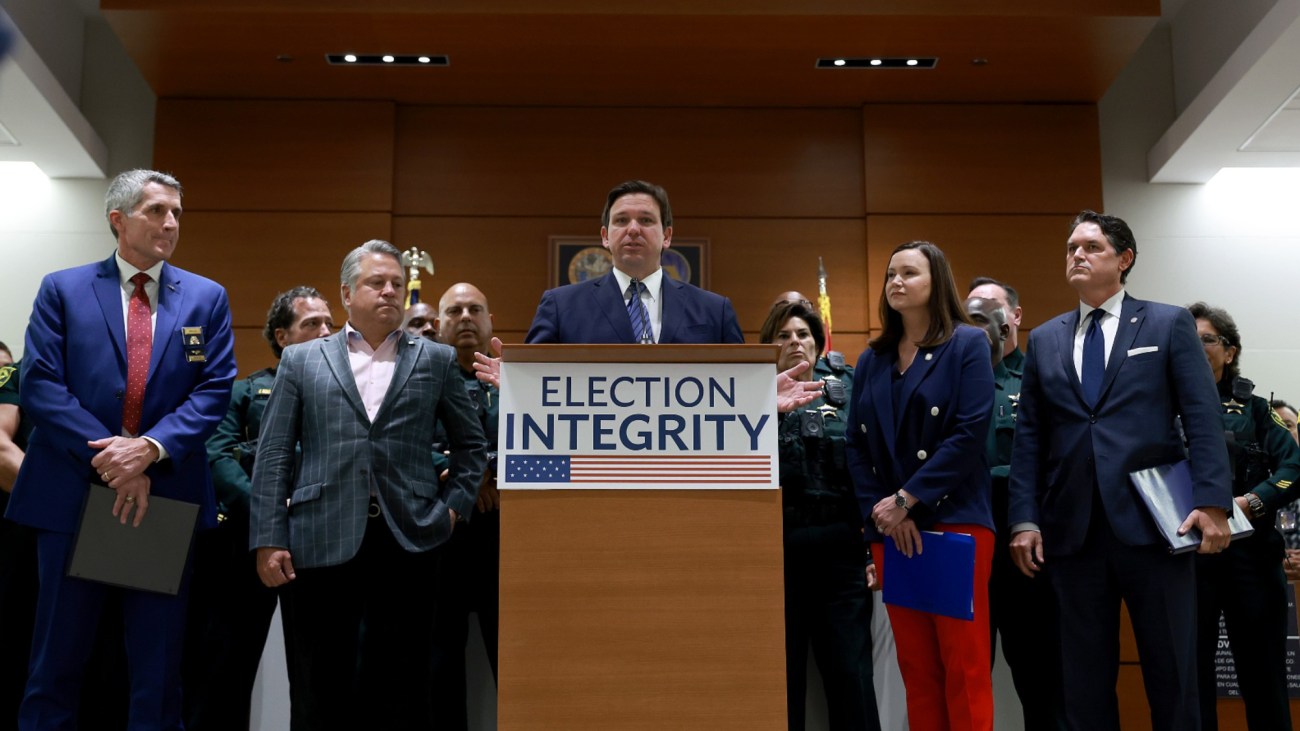 |
| Big Boss Ron and his thuggish looking toadies |
Measure the man by that stunt he pulled with his fuck-the-felon voter putsch, while privately permissively toward his golf-cart elderly villagers who voted in two states while knowing it was wrong but only getting a wrist slap pretrial diversion as "punishment." BOTTOM LINE: Ron DeSantis can't tell election integrity from a hole in the ground.The lectern should be saying "fuck-the-felons and fuck every voter who voted for the initiative to restore former felon rights. I'm Big Boss Ron!"
Presidential? Or better fit to be Trump's Mar-a-Lago caddie or butler?
____________FURTHER UPDATE____________
What DeSantis did was serious and mean voter intimidation. And he was boastful about it.
It is as easy to vent against DeSantis as it is against Ted Cruz.
They are similar. To understand what galls me the most, I imagine the two of them in a canoe, each paddling in the opposite direction because each wants things his way or no way, adamant, no matter what might make sense. Equal on the charm scale, neither unpinning the needle from zero. Bluster city.
That said, it appears interesting that Judge Robert L. Hinkle, the judge reported as presiding in the Warren v DeSantis trial, had previously in May 2020 held the Florida statute under which DeSantis had the various felon persons publicly arrested and shamed, an impermissible poll tax.
That was widely reported.
So, Warren v. Desantis gets a trial judge capable of seeing through a smoke screen.
Not a good sign for DeSantis playing heavyweight intimidator. Against the coarsely treated felons. Strike one. Against the self-motivated prosecutor setting office goals and policy under budget and as a dimension of prosecutorial discretion? Strike two?
We shall see.
Biggest surprise? Like Cruz, DeSantis got reelected.
.........................................
Coverage of Wednesday's day two of the trial -
During day two of the trial, we heard stunning testimony from DeSantis’ top advisors
First up was the governor’s chief safety czar – Larry Keefe – who oversaw the suspension and had numerous conversations with state attorneys and sheriffs across Florida, asking them if they knew of any state attorneys that weren’t enforcing the law.
Judge Hinkle zeroed in on if the conversations – and ultimately the suspension – were political.
The judge asked Keefe if any of the officials contacted were Democrats. Keefe paused before telling the court he couldn’t give specific examples.
Next to the stand was an unpaid intern for the governor who wrote up the controversial memo weighing the benefits and drawbacks of suspending Warren.
Communications director in the executive office of the governor, Taryn Fenske testified the suspension wasn’t politically motivated and would have happened even if Warren was a Republican.
The trial will continue on Thursday.
Wasn't political? Get real. It was over abortion politics, Keefe already admitted that, day one.
Realistically, would a Republican prosecutor, in Florida, anywhere there, have signed pledges originating from the National Advocacy Group Fair and Just Prosecution - pledges against abortion restrictions and transgender bias? No way!
That communications director is a joke of a human, saying it was not political. She did mean it was not overtly partisan, but the poll tax - felon intimidation was not overtly partisan either, just poor predominantly ill-informed black folks rounded up, shamed. That felon arrest ploy, stinking of voter intimidation politics.
And the judge on top of the trial, interjecting his own clearly relevant question. It looks dark for DeSantis' chance to prevail. Again, however, we have to wait.
___________FURTHER UPDATE__________
RESULT OF FURTHER WEB SEARCH
The 11th Circuit (ultimately) reversed the District Court's determination that a poll tax was at issue; Jones v. Governor of Florida, 975 F. 3d 1016 (1th Cir. 2020) rev'g, Id. 950 F. 3d 795 (11th Cir. 2020). The circuit court en banc reversed a circuit court per curium panel; read both, decide in your mind what is legitimate and what is bogus.
Wrong ultimate resolution in the opinion of many, but the last word from the federal courts is DeSantis prevailed, judicially. In the minds of level-headed citizens, opinions differ. DeSantis had no real cause to do this except to intimidate and to hence bias voting in Florida. Or that is the opinion Crabgrass holds; and with that whole exercise in mind, it is more proof DeSantis is an asshole.
Opinions can differ.
The entire set of "Jones" decisions can be read here.
DeSantis precipitates pissing matches, Jones and now Warren. The final viewpoint Crabgrass cares to share, Andrew Warren now has a recognized name and stature statewide and nationwide, and should run next cycle for Governor of Florida. It might be a vacant seat if the Republican party nominates DeSantis for Pres. or VP; otherwise Warren will have a shot at ousting DeSantis unless Florida has a two-term Guv limit in place. There would be a form of justice if Warren were to run and win.
Florida is a swamp. Warren is one of the good people there. The 11th Circuit is suspect of its own swamphood. End of Jones story.
The Warren story is still quite preliminary, being only now at trial.
____________FURTHER UPDATE___________
As the trial wrapped up Thursday evening, Judge Hinkle told the lawyers he would begin reviewing the case in two weeks, the earliest his schedule would allow.
Any news later will be separately posted, not added here as an UPDATE.
Subscribe to:
Posts (Atom)