"A judge has dismissed a defamation lawsuit brought by UnitedHealth Group against The Guardian over an investigative article alleging the healthcare giant secretly paid nursing home employees bonuses to reduce hospital transfers of Medicare and Medicaid patients."
The Guardian post under litigation resulting in dismissal of all UnitedHealth counts:
UnitedHealth
Group, United Healthcare Services and Optum had sued the news
organization, alleging the article was defamatory and defamatory by
implication.
The
Guardian's U.S. entity sought dismissal under Rule 12(b)(6), arguing
the complaint failed to state a legally viable claim. The Guardian's
U.K. parent companies separately moved to dismiss for lack of personal
jurisdiction under Rule 12(b)(2) or, alternatively, for failure to state
a claim.
After
reviewing the article, legal briefs and oral arguments, the court sided
with the defendants. "For the following reasons, after reviewing the
Article, the parties' briefing, and oral argument, the Defendants'
Motions to Dismiss are GRANTED," the opinion stated.
"[...] Today's decision is a vindication of The Guardian's
deeply sourced, independent reporting, and a rejection of UnitedHealth's
bullying and intimidation tactics."
[...] The
decision represents an early victory for The Guardian in a closely
watched case involving investigative reporting into one of the nation's
largest healthcare companies. It was not immediately clear from the
opinion whether the dismissal was with prejudice, which would prevent
UnitedHealth from refiling its claims, or whether the company could
amend its complaint or appeal the decision.
Representatives for UnitedHealth did not immediately respond to TheWrap's request for comment.
HEADLINE: UnitedHealth reduced hospitalizations for nursing home seniors. Now it faces wrongful death claims - The
company says it is protecting nursing home residents by curbing
unnecessary hospital transfers. Whistleblowers allege cost-cutting
tactics have endangered the elderly
Three nursing home residents died because employees of the American healthcare giant UnitedHealth Group helped delay or deny them critical hospital care, two pending lawsuits and a complaint to state authorities have alleged.
The
three cases involve a UnitedHealth partnership initiative that places
medical staff from the company’s direct care unit, Optum, inside nursing
homes to care for residents insured by the company’s insurance arm.
UnitedHealth says one of the initiative’s goals is to protect patients by reducing unnecessary hospital admissions. Those are admissions the insurance giant would otherwise have to pay for.
In Georgia, the family of a woman named Cindy Deal filed a lawsuit alleging
that the 58-year-old died because Optum and her nursing home failed to
hospitalize her for hours after she started foaming at the mouth and
appeared to be having a seizure.
In Ohio, the family of a retiree named Mary Grant filed a lawsuit claiming
that the 70-year-old died after Optum and Grant’s nursing home failed
to send her to the hospital, though she had suffered a traumatic head
injury and began vomiting.
In New York, a physician’s assistant named
Christopher Bieniek alleged in a complaint to state authorities that a
63-year-old nursing home resident died due to “gross negligence” by an
Optum employee. The employee refused to hospitalize the man, despite his
kidney failure, according to text messages Bieniek says he shared with
state investigators.
Citing patient privacy
rules and pending litigation, UnitedHealth’s public relations team did
not directly respond to specific questions about the three cases, but
said that many of the claims were unsubstantiated or based on incomplete
or embellished information.
The company has previouslydenied the Grant and Deal families’ claims in court, and attorneys representing UnitedHealth disputed some of Bieniek’s claims.
“We
remain confident in our transparency, our compliance and our steadfast
commitment to patient-centered care,” the company said. “We will not
legitimize a one-sided and misinformed narrative by further engaging
with it. Our focus continues to be where it belongs: delivering
high-quality care for our members and standing with the clinicians and
care teams who devote themselves every day to improving patients’
lives.”
The three cases highlight the dual
role that UnitedHealth has taken on for thousands of nursing home
residents across the country: medical insurer and provider of direct
care.
Like many American health insurers,
UnitedHealth has expanded across the healthcare sector and no longer
limits itself to simply paying or denying its members’ medical bills.
In nursing homes, for example, the conglomerate deploys its own army
of nurse practitioners and physician assistants from its medical
services arm, Optum, to care for seniors covered by its insurance arm,
UnitedHealthcare. During the day, these medical professionals listen to
heart sounds, decide on new diagnoses, and address dangerous
complications for insured residents at their nursing homes. At night and
on weekends, other Optum employees on hotlines weigh in on their care
from afar.
UnitedHealth insures more than 55,000 long-term
nursing home residents through what are known as institutional special
needs plans (I-SNPs), which are funded through the federal government’s
Medicare Advantage program. While other insurers also employ their own
medical providers, UnitedHealth is by far the biggest player in the I-SNP market, covering almost as many residents as all of its rivals combined.
UnitedHealth says this hands-on nursing home model provides an “extra layer of caring support”
that helps reduce unnecessary hospital trips for long-term residents at
more than 1,900 nursing homes in 29 states across the US. “United works
with the nursing facility, primary care physicians, and specialists to
deliver appropriate care for members in the most appropriate setting,”
the company said in an email, noting that a non-profit called the
National Committee for Quality Assurance recently awarded its care model
a 98.75% score.
Hospitalizations, the company
notes, can lead to serious issues for nursing home residents, such as
delirium, falls and pressure injuries.
They can also lead to major expenses for the insurance giant, a financial arrangement that lawmakers
and corporate whistleblowers have framed as a potential conflict of
interest incentivizing the conglomerate to discourage necessary
hospitalizations too.
Under Medicare
Advantage, the government pays insurers like UnitedHealthcare a set
amount of money based on the expected healthcare needs of each senior
enrolled in their insurance plans for long-term nursing home residents.
The less insurers spend on residents’ care, the more they have left over
in taxpayer funds for potential profit.
In
addition to the complaints from the families and the outside medical
provider, UnitedHealth’s nursing home initiative has been the subject of
at least four whistleblower complaints from former employees. The
whistleblowers allege that employees from Optum, UnitedHealth’s direct
care subsidiary, engaged in unethical tactics that sought to curb costly
but critical hospital care, or violated federal rules meant to protect
nursing home residents from predatory insurance sales tactics.
Two
of the whistleblowers, both former Optum nurse practitioners, filed
declarations with Congress, alleging that company managers improperly
pressured them to reduce hospital transfers for nursing home seniors,
and to get residents on to medical directives, such as
“Do-Not-Resuscitate” orders, that could pre-empt costly emergency room
care. The declarations also allege that supervisors pushed them to
creatively code patient diagnoses to increase federal payments for the
company.
UnitedHealth said it categorically
rejected any suggestion that its employees engage in practices that
endanger patient safety or violate ethical standards. It said that the
suggestion that its employees prevented hospital transfers was false,
and that its permission was not required for nursing home residents to
go to the hospital.
The company added that
“the insinuation that the desire to decrease unnecessary
hospitalizations is motivated solely by financial considerations ignores
well established evidence of the harm unnecessary hospitalizations can
cause.”
Policy experts say reducing
unnecessary hospitalizations is important to cutting wasteful
expenditures and protecting frail nursing home residents, but caution
that these efforts must allow medical providers to follow their genuine
clinical judgments.
“You don’t want to then
overcorrect and basically align the incentives so that people are never
sent to the hospital when they really need to go to the hospital for
appropriate care,” said Gretchen Jacobson, vice-president of Medicare
policy at the Commonwealth Fund, a healthcare research non-profit.
Medical researchers have found that a sizable portion of hospitalizations of nursing home residents may be unnecessary. A study
published in July in the medical journal JAMDA, for example, found that
one-third of hospital admissions among thousands of “severely impaired”
nursing home residents appeared to be “potentially avoidable
hospitalizations”.
[...] In June, UnitedHealth sued the
Guardian alleging defamation for a previous story about UnitedHealth’s
efforts to reduce hospitalizations among nursing home residents.
The
lawsuit from the healthcare giant, which brought in more than $400bn in
revenue last year, was the latest in a series of aggressive tactics
aimed at quieting its critics, the New York Times reported.
In
the wake of the suit, the Guardian stood by its story, and continued
its reporting process, which identified the three allegations of
wrongful deaths.
These allegations, as well as
details from four whistleblower complaints about United Health’s I-SNP
nursing home program, have never previously been made public by the
press or government agencies.
“We are
disappointed the Guardian has continued a pattern of biased and
misleading reporting that does not reflect the value of the I-SNP
clinical model or the benefits we provide to our members,” UnitedHealth
said in a statement. “The inaccuracies have been so persistent and
harmful we have pursued legal action – an extraordinary step we take to
protect the integrity of our work, our care teams and the people we
serve.”
After the Guardian published its first story on UnitedHealth’s nursing home initiative, Senators Ron Wyden and Elizabeth Warren held a briefing with UnitedHealth about its nursing home program and decided to launch an investigation seeking company documents.
“Nursing
home residents and their families should not live in fear of a
for-profit health care company withholding care when it is most
critical,” the senators wrote in a letter to the company.
A whistleblower’s complaint
When
Maxwell Ollivant first started working as a nurse practitioner for
UnitedHealth’s nursing home program, he believed in his company’s care
model.
Maxwell Ollivant. Photograph: George Joseph/The Guardian
As
an employee of UnitedHealth’s direct care subsidiary, Optum, Ollivant’s
job was to visit and check on dozens of seniors at three nursing homes
in the suburbs of Tacoma, Washington. The goal: to identify medical
complications early and address them, protecting residents from needless
hospitalizations.
Ollivant was excited to
work in geriatric care. When he was young, his grandfather had supported
him after the shock of his parents’ divorce. Now he would be able to
care for seniors like him.
Less than a year
into the new job, however, the nurse practitioner, a committed
Christian, started to have concerns that his company was going too far,
inserting itself into nursing home emergencies and effectively delaying
or discouraging necessary hospitalizations, according to the lawsuit and
congressional declaration he later filed.
When
Ollivant visited his assigned nursing homes, he saw images with large
red STOP signs in his patients’ charts, according to the declaration
Ollivant filed in May with Congress as well as the Securities and
Exchange Commission, the Federal Trade Commission and the Washington
state attorney general. The signs instructed nursing home staff to call
UnitedHealth’s Optum unit first, rather than their independent primary
care doctors, when a patient’s condition worsened, the declaration said.
If
a nursing home did send a patient to the hospital without first
contacting Optum and following various protocols, Ollivant and his
colleagues “were instructed to chastise the nursing facility staff”, the
declaration said.
Such scrutiny could even
follow a hospitalization for an emergency situation, as one Optum email
stemming from Ollivant’s litigation indicates.
In
that case, nursing home staff sent a resident to the hospital because
she was found drooling, unresponsive and with a “slant to the side”, the
email said. Thesymptoms
pointed to a possible stroke, an emergency that requires rapid
treatment, and the woman was subsequently admitted to a hospital’s
intensive care unit for “intrabrain bleeding”, a life-threatening type of stroke, according to the email.
But
after the transfer, Ollivant’s manager emailed her team that the
nursing home had sidestepped the company’s protocol, failing to take the
time to first call a hotline operated by Optum’s off-site medical
staffers.
“This is by pass,” the manager
wrote, referring to Optum’s term for when nursing home staff skipped
over its intermediary clinicians to hospitalize a resident. “Nursing did
not call Optum on call.”
The manager then met
with the nursing home’s director of nursing services and scheduled an
in-service training to re-educate the facility’s nurses, the email
shows.
UnitedHealth did not directly respond to questions about this email.
Four months later, Ollivant went to UnitedHealth’s HR team with
concerns about his company’s response to another emergency, involving a
patient of his, public records from the Washington state attorney
general show.
One Sunday earlier in September,
the 66-year-old nursing home resident had been found with potential
stroke symptoms, but his transfer to a hospital was delayed after his
nursing home contacted UnitedHealth’s on-call hotline, instead of an
independent doctor, according to Ollivant’s lawsuit, which referred to
the man by his initials, “M.T.”
For Ollivant,
the incident showed the danger of Optum’s involvement in emergency
cases, according to the congressional declaration he later filed.
In
its defamation suit and in statements to the Guardian, UnitedHealth
maintained that it repeatedly pushed for M.T.’s transfer and faulted its
nursing home partner for failing to hospitalize the retiree earlier.
Days
after Ollivant reported his concerns about M.T. to UnitedHealth’s HR
department, the company began investigating the nurse practitioner
himself, records released by the company to the Guardian show. It
concluded that Ollivant had failed to properly care for M.T. during a
second incident which the nurse practitioner had also complained about,
according to the company records.
Ollivant submitted his resignation that February – just over three weeks after he filed his internal complaint.
The
nurse practitioner later sued UnitedHealth, then voluntarily dismissed
his suit after the US Department of Justice declined to intervene in the
case. In early May, with the assistance of the legal advocacy
organization Whistleblower Aid, Ollivant submitted his declaration to
state and federal authorities expanding on his previous claims.
In
a statement, UnitedHealth said that Ollivant was “not in a position to
assess the effectiveness of our programs”, claiming he “lacks both the
necessary data and the expertise”.
“Our
position is supported by peer-reviewed studies and measurable outcomes,”
the company said. “In contrast, the criticisms being raised are based
on anecdotes.”
Between July 2024 and June
2025, long-term nursing home members covered by UnitedHealth experienced
38,000 transfers to the ER and 16,000 hospital admissions, the company
said. Of those admissions, it said, nearly half were ordered by skilled
nursing facilities or primary care physicians without Optum’s
involvement.
UnitedHealth also said that the
Department of Justice investigated the whistleblower claims,
interviewing witnesses and obtaining thousands of documents that
“demonstrated significant factual inaccuracies in the allegations”.
UnitedHealth previously told the Guardian that the Department of Justice
found the allegations to be “meritless” and “found no evidence of
wrongdoing”.
UnitedHealth did not respond to requests from the Guardian that it provide evidence for this claim.
‘The goal is to treat in place’
Mary Grant, the nursing home resident in Ohio, never made it to the hospital.
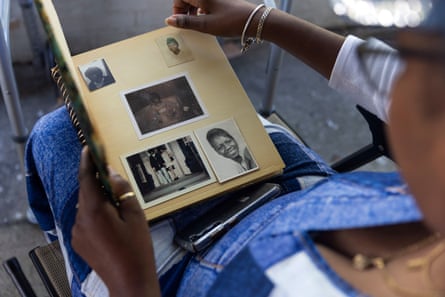
Photographs of Mary Grant in a family album. Photograph: Maddie McGarvey/The Guardian
One
evening two years ago, when a nurse at her facility in Cleveland found
the 70-year-old low on oxygen and covered in pinkish chunks of vomit,
she called the care hotline operated by UnitedHealth’s Optum subsidiary,
instead of an independent doctor, according to nursing notes and an
Optum audio recording released through litigation.
The
day before, a nursing home employee had accidentally rammed a cart into
Grant, knocking her out of her wheelchair, according to a lawsuit that
her family filed in state court in Ohio and was later moved to federal
court. Her head, protected only by strands of thin, gray hair, hit the
concrete floor, leaving a bump on her forehead, patient records released
through discovery and the lawsuit assert.
Now Grant was experiencing nausea and vomiting – signs
of potential bleeding inside her head, according to a doctor who later
filed an affidavit as part of the lawsuit. To assess whether Grant was
bleeding internally and needed surgery, she needed to go to a hospital
and get a CT or MRI scan, the suit claimed.
But
the Optum hotline employee that the nursing home nurse called for
instruction “did not order” Grant’s transfer to the hospital, according
to the suit. After hearing about the fall and head bump from Grant’s
daughter and Grant’s vomiting and low oxygen levels from the nurse, the
Optum liaison determined that a transfer was not yet necessary,
according to a UnitedHealth call log disclosed in response to the suit.
“The goal is to treat in place,” a log from the Optum employee noted later that evening, using language reflecting the company’s efforts to curb unnecessary hospital transfers. “But if condition worsens, send to Soft Point [sic] hospital.”
The
Optum employee told the nursing home to continually check Grant’s vital
signs, order a chest X-ray at her facility, and give her medicine and
oxygen, company logs and audio recordings released through discovery in
the suit show.
This plan of care that Optum
coordinated with its nursing home partner failed to reckon with the
possibility that Grant had suffered a traumatic head injury that was
causing a growing pool of blood to compress the tissue in her brain,
according to court filings by her family.
The next day, nursing home stafffound the retiree dead in her room, according to nursing home notes released through litigation.
In
August, attorneys Michael Hill and Matthew Mooney filed a lawsuit on
behalf of Grant’s family alleging that the off-site nurse practitioner
for UnitedHealth’s Optum unit was not acting “as an independent and
objective medical professional” on the company’s hotline, but instead as
“an insurance adjuster” so that the healthcare giant could
“preemptively deny Mary Grant necessary medical care”.
In a court filing, UnitedHealth denied the Grant family’s allegations.
UnitedHealth’s
public relations team did not directly respond to questions about the
Grant case, but said in a statement: “Where litigation is ongoing, we
are limited in what we can share, but we contest inaccuracies and will
vigorously defend ourselves.”
Allegations of upcoding and changing medical orders to increase federal dollars
The
other former Optum employee who filed a whistleblower declaration with
Congress submitted it while still working at the company. Like Ollivant,
the clinician – who has chosen to remain anonymous – said they were
initially supportive of UnitedHealth’s nursing home initiative.
Once
on the job, however, the nurse practitioner discovered that their team
was under pressure to reduce hospitalizations while inserting
questionable diagnosis codes into patients’ charts in order to increase
federal payouts to UnitedHealth, according to the declaration provided
to state and federal agencies.
“It felt so
unprofessional and bizarre, based on other medical facilities I worked
in, to have managers challenge well-established critical interventions
in cut-and-dry cases,” the whistleblower wrote.
Bonuses
went to nurse practitioners who rarely transferred residents to the
hospital and who mined colleagues’ charts for lucrative diagnosis codes
they could use to bill the federal government, the nurse practitioner
wrote.
Staff went through training to learn
how to deploy diagnosis codes for weak foot pulses and minor skin
spotting, and would be re-educated by company coding specialists if
their coding was deemed insufficient, the declaration alleges.
“These
changes in codes did not change the treatment plan, but they did
generate higher Medicare Advantage payments for UnitedHealthcare,”
according to the declaration.
UnitedHealth did
not directly respond to a question on the allegations about its
employees coding patient diagnoses to increase federal dollars. But the
company said in an email that the Centers for Medicare and Medicaid
Services gave UnitedHealth’s nursing home plan a 4.5 star rating.
The
declarations from the anonymous whistleblower and Ollivant also alleged
that UnitedHealth’s Optum unit pushed to get nursing home residents to
consider medical directives, such as “Do-Not-Resuscitate” and
“Do-Not-Hospitalize” orders, which can limit access to life-saving
interventions and pre-empt costly hospitalizations.
UnitedHealth pointed out that advanced care planning had a positive
impact on the quality of residents’ end of life care and said that the
company tracked residents’ care preferences “to align the care provided
with the patient’s health and care goals”.
In the declaration, the anonymous whistleblower acknowledged that
advanced care planning was “very necessary”. But Optum staff, the nurse
practitioner wrote, sometimes convinced patients to agree to orders
limiting their care through counseling that failed to make clear that
some of their ailments may be reversible, and that patients with chronic
conditions might still benefit from hospitalization for less serious
complications.
“This resulted in what seemed
to be a de-escalation of care,” the whistleblower wrote, for patients
“who desired to live longer without extraordinary measures but still
sought treatment for manageable conditions”, such as heart failure,
urinary tract infection, or acute kidney injury.
In his declaration, Ollivant echoed these concerns, describing the
conglomerate’s “push” for “Do-Not-Resuscitate” and “Do-Not-Hospitalize”
orders as an “unconscionable measure” that sought to reduce
UnitedHealth’s costs while increasing its profits.
UnitedHealth denies these claims.
The
company said Optum clinicians are trained to have high-quality
conversations about advance care planning to allow members and families
to make the most informed decisions possible. The company said that it
had never encouraged or pushed a member to sign a “Do-Not-Hospitalize”
or “Do-Not-Resuscitate” order.
“Our health
care providers are ethically bound to respect patient autonomy and
support informed decision-making,” UnitedHealth said in an email.
UnitedHealth’s
June lawsuit criticized the Guardian’s previous reporting on
allegations about its advanced care planning practices. Company
whistleblowers, however, were not alone in questioning its discussions
with patients and their families about such care directives.
More concerns about UnitedHealth’s end-of-life planning push
In
August of 2023, Christopher Bieniek, a physician assistant working for
an independent medical group in upstate New York, filed a complaint with
state authorities alleging that “gross negligence and incompetence” by
an Optum nurse practitioner working at a nursing home alongside him
“resulted in the death” of a resident experiencing congestive heart
failure and kidney failure.
According to the
complaint, the 63-year-old resident was complaining of dizziness and had
very low blood pressure. But when Bieniek pushed for the resident to go
to the hospital citing his kidney failure, the Optum employee simply
responded “no”, according to text messages Bienek says he showed to
investigators from New York’s office of professions, the state’s
licensing authority.
“No?
He has symptomatic hypotension with end organ dysfunction,” Bieniek
replied on the text chain, noting that the man needed rapid IV fluid
injections which he could not receive at the nursing home. The
63-year-old’s medical orders form “says to send to hospital when
medically necessary”, Bieniek pointed out.
Instead of helping to get the man to the hospital where he might have
received costly but life-saving care, Bieniek alleged in his complaint,
the Optum employee “talked the family into changing” his care goal to
comfort care – an end-of-life approach – “despite the condition being
readily treatable and probably reversible even at that late stage”.
The
nursing home resident died soon thereafter, according to Bieniek’s
complaint, which specifically pointed to UnitedHealth’s financial stake
in his patient’s care.
[... ]
The item is long and detailed,
with much more to read. Crabgrass chose to terminate the quote, already lengthy, as
sufficient to show some issues and responses of the giant corporation.
Readers are urged to follow the link if wanting the entire story.
From the excerpt, as quoted, Crabgrass believes it shocks the conscience to see facts Guardian alleged, if true, in its reporting. Again, as noted, Crabgrass did not try to access online court documents, which somehow might have lessened that "shocks the conscience" opinion Crabgrass reached, based upon Guardian's coverage.
UnitedHealth
sued, claiming the article contained numerous false accusations. Among
them: The health care company secretly paid nursing homes to enroll
patients in UnitedHealthcare insurance and then coerced residents to
sign do-not-resuscitate (DNR) orders, preventing costly hospitalizations
and lifesaving treatments.
On
the DNR issue, the judge wrote: “Nothing in the article states that
United was approaching [patients] and telling them to change their code
status so [United] could save money.”
The indication is there was, over time, ongoing Strib coverage of the situation, and readers who can access the site's paywalled stories have those links Strib included.
It appears that Strib was not sued over anything it published about the situation.
That item - an executive summary to a linked full report - suggests that even if no other healthcare related firm did as Guardian reported about UnitedHealth conduct, the reach of the shock of the reporting is great because of the substantial leading position UnitedHealth has; it's biggest player in healthcare insurance. The 800 pound gorilla in the market.
The obvious answer to private firm abuse or possible abuse of the USA healthcare set-up existing today, as Crabgrass sees things, is to do away with insurance except for extended supplemental private-sector coverage, while enacting by law, ASAP,
Medicare for All, and nothing less.
That would be as a basic universal coverage human right and not as a pubic option to anything else. Anything purchasable from the private sector would be solely supplemental coverage. There would, of course as with Medicare now for senior Americans, have to be rules and limits of what could be covered. There would have to be cost cap planning, because nobody in their right mind would want the healthcare providers to have a blank check from the government. They'd abuse it.
FURTHER: Strib's coverage links to the online biography of the trial judge dismissing the Delaware lawsuit. He has outstanding credentials in the legal community, and the case was filed in the state of incorporation of the firm suing, not as a federal case.
Is summarizing the court's decision, Strib reported:
In
one count, the judge wrote that UnitedHealth Group’s lawsuit “cherry
picks” language to allege the Guardian was making claims that weren’t
actually part of its report.
Scott
dismissed another count after finding the news outlet’s story was
“substantially true” in characterizing certain nursing home bonus
payments from UnitedHealth Group as “secret,” or made “secretly” or
“quietly.”
And
responding to the company’s complaint that omissions in the news report
created a false impression, the judge wrote that the Guardian “is not
required to publish facts just because United would have preferred more
favorable facts. The omissions do not render the statements false.”
Again, Crabgrass made no attempt to find and review court papers online before posting. The post is limited to reporting of coverage by recognized online outlets. With brief added editorial comment.
FURTHER: It should be obvious that the story is important to the upcoming November election because healthcare deficiencies will be a major issue.
Incumbent Congress members, collectively, while having full terms have not delivered Medicare for All.
That might not relate to particular Reps or Senators who as a minority have continuously advocated for it, but if you are unsure when filling out your ballot, do not undersell this negligent aspect of incumbancy by granting incumbancy too great a privilege. There are large amounts of private donor money behind the foot dragging that, in general, has repeatedly been seen or postulated.
Clean house if unsure. Let new voices in. In the general election and if your state has not yet had primary elections. Minnesota's primary will be in August. Try to be as informed as feasible about the political stances of each politician on your ballot.