
So I naturally put more emphasis on the Venezuela oil capture exercise than most would.
Out of curiosity, I asked the Duck.ai bot, "are us oil refineries refining venezuelan oil" and got an answer that included a link dated January 15, 2026 to https://news.oilandgaswatch.org/post/u-s-oil-refinery-investors-not-consumers-will-benefit-from-seizure-of-venezuelan-oil
Titled, U.S. oil refinery investors, not consumers, will benefit from seizure of Venezuelan oil, the January item stated in part:oil
The U.S. military’s seizure of Venezuela’s oil exports is unlikely to lower gasoline prices for consumers – as President Donald Trump has claimed – but could funnel billions of dollars to American oil companies that donated to Trump’s election, according to industry analysts.
“The refineries can benefit tremendously from this–not just from the free oil that they may be getting–but the type of oil,” said Paasha Mahdavi, an energy industry expert and professor at the University of California, Santa Barbara. “But that benefit will not be passed on to consumers.”
Among the oil refinery owners who could benefit is billionaire Trump donor Paul Singer, founder of an investment management company that is buying Citgo Petroleum, a refining firm owned by Venezuela’s state oil company. Citgo has refineries in Texas and Louisiana that are already geared to process the kind of heavy crude oil produced by Venezuela. Singer donated about $8 million to Trump’s election campaign and $1 million to his inaugural committee.
Also positioned to potentially cash in are ConocoPhillips, ExxonMobil, and Chevron, which also gave millions to Trump’s political campaign. The first two companies have been seeking a combined $32 billion in reparations from Venezuela for seizing their oil drilling infrastructure in the country in 2007, after the nationalization of the country’s oil resources.
Chevron, based in Houston, could also benefit because it is the only U.S. oil company still drilling in Venezuela and also has a refinery on the U.S. Gulf Coast that is designed to handle heavy Venezuelan crude oil.
[...] Six Democratic U.S. Senators, including Sheldon Whitehouse of Rhode Island and Bernie Sanders of Vermont, announced on Jan. 8 that they are launching an investigation into the Trump Administration’s communications with oil company executives about military strikes in Venezuela before and after the capturing of President Nicolas Maduro. The lawmakers are seeking to find out if the administration launched the attack to benefit an industry that contributed heavily to Trump’s election.
[...] Patrick De Haan, lead petroleum analyst at GasBuddy, said that the international price of oil is fairly low right now (below $60 per barrel), while the risk and cost of extracting more oil from Venezuela is high. In this market, he does not believe that U.S. oil companies will find it profitable to step up and invest their own money in extracting more oil out of Venezuela. Some economists believe such investments would require a price above $80 per barrel.
[...] Abhi Rajendran, director of oil markets research at Energy Intelligence, said that oil production from Venezuela – already down substantially, in part because of sanctions imposed by the first Trump Administration in 2017 and 2019 -- could continue to drop in the short term. [...] “Definitely the refiners stand to benefit from this, like Valero and Phillips 66 that have refineries on the Gulf Coast,” Rajendran said. “They are the big winners. And the one company that has the boots on the ground and the capacity to invest and ramp is Chevron, because they are already there in Venezuela.”
That was then. Now is now, with a 20% shrinkage in daily oil volume on the market with Hormuz shut.
https://www.iea.org/reports/oil-market-report-march-2026 - noted:
The war in the Middle East is creating the largest supply disruption in the history of the global oil market. With crude and oil product flows through the Strait of Hormuz plunging from around 20 mb/d before the war to a trickle currently, limited capacity available to bypass the crucial waterway, and storage filling up, Gulf countries have cut total oil production by at least 10 mb/d. In the absence of a rapid resumption of shipping flows, supply losses are set to increase.
Global oil supply is projected to plunge by 8 mb/d in March, with curtailments in the Middle East partly offset by higher output from non-OPEC+ producers, Kazakhstan and Russia following disruptions at the start of the year. While the extent of losses will depend on the duration of the conflict and disruptions to flows, we estimate global oil supply to rise by 1.1 mb/d in 2026 on average, with non-OPEC+ producers accounting for the entire increase.
The conflict is also having a significant impact on global product markets, with export flows through the Strait at a near standstill. Gulf producers exported 3.3 mb/d of refined products and 1.5 mb/d of LPG in 2025. More than 3 mb/d of refining capacity in the region has already shut due to attacks and a lack of viable export outlets. Runs elsewhere will be increasingly limited due to feedstock availability.
IEA Member countries unanimously agreed on 11 March to make 400 mb of oil from their emergency reserves available to the market to address disruptions stemming from the war in the Middle East. Global observed oil stocks were 8 210 mb in January, their highest level since February 2021. The OECD accounted for 50%, Chinese crude stocks 15%, oil on water 25%, with the remainder in other non-OECD countries.
Widespread flight cancellations in the Middle East and large-scale disruptions to LPG supplies are expected to curb global oil demand by around 1 mb/d during March and April compared to previous estimates. Higher oil prices and a more precarious outlook for the global economy pose further risks to the forecast. Global oil consumption is now set to increase by 640 kb/d y-o-y in 2026 – down 210 kb/d from last month.
Oil prices have gyrated wildly since the United States and Israel launched joint air strikes on Iran on 28 February. Disruptions to Middle Eastern supplies due to attacks on the region’s oil infrastructure and the cessation of tanker traffic through the Strait of Hormuz sent Brent futures soaring, trading within a whisker of $120/bbl. Prices subsequently eased with Brent around $92/bbl at the time of writing – up $20/bbl for the month.
Dire straits
The global oil market is contending with the ramifications of the war in the Middle East. Beyond the direct damage to energy infrastructure in the region, the crisis has led to a near halt in tanker movements through the Strait of Hormuz. With nearly 20 mb/d of crude and product exports currently disrupted and limited alternative options to bypass the world’s most critical oil transit chokepoint, producers and consumers globally are feeling the strain. Benchmark crude oil prices have surged by $20/bbl to $92/bbl since the outbreak of hostilities on 28 February, with even bigger increases across product markets.
Trump professes a hope and intention for a quick end of Iran's chockhold on Hormuz. He references nuclear bomb concerns as a sticking point.
Oil Refinery Statistics in US 2026 | Capacity, Output & Key Facts - May 2, 2026 states:
Oil Refining in America 2026
The United States petroleum refining industry sits at a genuine inflection point in 2026 — one where decades of infrastructure dominance, record-breaking export performance, and some of the highest-capacity facilities on the planet are running alongside a wave of closures, shrinking margins, and a structural shift toward renewable fuels that is beginning to permanently reshape the domestic refining map. As of January 1, 2025, the U.S. Energy Information Administration (EIA) Refinery Capacity Report — the most authoritative federal survey of domestic refining infrastructure — documented 132 operable refineries with total atmospheric distillation capacity of 18.4 million barrels per calendar day (b/cd), virtually unchanged from 2024. Yet that flat headline number obscures a more complex story unfolding beneath it: the LyondellBasell Houston refinery permanently ceased operations in January 2025, removing 263,776 b/cd of capacity; the Phillips 66 Los Angeles refinery began its phased shutdown in October 2025, eliminating a further 139,000 b/cd; and Valero’s Benicia, California refinery is targeting permanent closure by April 2026 — removing yet another 145,000 b/cd from the US fuel supply chain. Together, these three closures are cutting roughly 550,000 b/cd from US refining capacity — equivalent to wiping more than three mid-size refineries off the map in under 18 months.
Understanding the US refining industry in 2026 requires holding two realities simultaneously. On one hand, the country’s refining complex remains the most productive in the world: US petroleum product exports set a new annual record of 6.6 million barrels per day in 2024, refineries are operating at utilization rates near 95%, and the Gulf Coast refining corridor — home to more than 50% of national capacity — continues to supply not just the domestic market but growing volumes of diesel, jet fuel, and gasoline to Latin America, Europe, and Asia. On the other hand, crack spreads — the critical margin between crude oil input costs and refined product selling prices — have been declining steadily since their post-pandemic peak in 2022, making marginal and mid-size refineries increasingly unviable. Refinery margins for gasoline and diesel fell approximately 26–29% year-over-year in 2024, and the EIA’s own forecasts project US refining capacity will shrink to approximately 17.9 million b/cd by end of 2025 — a 3% contraction driven entirely by closures. For the world’s largest refining nation, that is a significant structural adjustment — and it is happening faster than most market observers anticipated.
[...] The record 6.6 million b/d in petroleum product exports in 2024 demonstrates the competitive strength of US refining infrastructure — American refineries are producing more fuel and refined products than the domestic market consumes, generating $102 billion in net trade income in 2022 alone. Yet the closure pipeline tells a different story: three major refineries removing a combined ~550,000 b/d of capacity in the span of 15 months represents the fastest contraction in US refining since the post-1982 downsizing that cut the industry from 301 facilities to under 200. The crack spread compression of 2024 — where gasoline margins fell nearly 27% and coking margins dropped 29% year-over-year — is the direct financial driver, and until margin recovery materializes, further rationalization of the bottom tier of US refining capacity cannot be ruled out.
[...] The US oil refinery capacity picture at the start of 2026 is defined by a combination of structural stability and accelerating contraction. The 18.4 million b/cd confirmed in the EIA’s 2025 Refinery Capacity Report reflects a system that has actually held its aggregate capacity more stable than historical patterns might suggest: the 2023 addition of ExxonMobil’s 240,000 b/cd Beaumont expansion — the single largest domestic capacity addition in recent memory — helped offset prior-year closures and brought total capacity to its highest level since 2019. But with no comparable large-scale expansion project in 2024, and with the loss of LyondellBasell, Phillips 66, and Valero capacity already underway or imminent, the EIA’s projection of 17.9 million b/cd by end-2025 represents the lowest US refining capacity level since the early 2010s.The geographic concentration of US refining capacity is one of the defining structural features of the industry and one of its most significant energy security considerations. With more than 50% of all US refining capacity concentrated in the Gulf Coast PADD 3 district — and Texas alone accounting for over 25% of national capacity — the US fuel supply chain is highly dependent on the uninterrupted operation of a relatively narrow geographic corridor. Hurricanes, extreme weather, and infrastructure disruptions in the Gulf Coast region have historically driven national gasoline and diesel price spikes, a vulnerability that the progressive closure of West Coast capacity only deepens. With California set to lose roughly 17% of its state refining capacity from the combined Phillips 66 and Valero closures, and given the limited pipeline connectivity between the West Coast and other US refining hubs, the EIA has explicitly identified the risk of West Coast fuel price increases and record gasoline import dependency in the 2025–2026 period.
[...] The geographic and corporate structure of America’s largest oil refineries reflects a century of investment decisions shaped by proximity to crude oil production, deepwater port access, and the logistics of the Gulf of Mexico energy corridor. All seven of the largest US refineries sit in the Gulf Coast PADD 3 district — four in Texas, three in Louisiana — and the concentration of capacity in this region is no accident. The Texas Gulf Coast, from the Houston Ship Channel through Beaumont, Port Arthur, and down to the Corpus Christi area, forms one of the most densely integrated petrochemical and refining complexes on earth. The Motiva Port Arthur refinery — owned by Saudi Aramco subsidiary Motiva Enterprises — reclaimed the title of largest US refinery by calendar day capacity in the 2025 EIA report, while Marathon’s Galveston Bay facility retains the top stream day position at 665,000 b/sd, capable of processing more crude oil per day than the entire national output of many mid-tier oil-producing countries.
The ExxonMobil Beaumont facility deserves particular attention as the most consequential recent development in US refinery capacity: the 2023 expansion added 240,000 b/cd to the site, bringing total throughput to approximately 609,000 b/cd and making it one of the most significant single-site capacity additions in US refining history in the past two decades. At the other end of the scale, the closure column of the table tells the more structurally significant 2025–2026 story: LyondellBasell’s Houston facility — which before its January 2025 shutdown produced approximately 140,000 b/d of gasoline and 100,000 b/d of diesel — has been permanently removed from the US fuel supply chain, and the combined exits of Phillips 66’s Los Angeles complex and Valero’s Benicia refinery are eliminating California’s most significant integrated refining operations outside of the Chevron Richmond facility.
[...] The wave of US refinery closures in 2025–2026 represents the most concentrated capacity contraction since the industry downsizing of the early 1980s — and it is playing out in a distinctly uneven geographic pattern. The three major closures removing approximately 548,000 b/cd are not distributed evenly: two of the three are concentrated in California, and the third — LyondellBasell’s Houston facility — was the result of a seven-year failed sale process in which the company could not find a buyer willing to operate a refinery with its cost structure and crude slate. California’s situation is unique and increasingly severe. Six refinery plants have shut down or converted since 2008 in the state, driven by a combination of California’s strict environmental regulations, the state’s declared goal of reducing gasoline use to one-tenth current levels by 2045, rising operating costs, and the premium economics of converting petroleum refinery infrastructure to renewable diesel production — which qualifies for California’s Low Carbon Fuel Standard credits worth approximately $3.70 per gallon in additional subsidy income.
The human cost of these closures is concentrated in specific communities where refinery work has historically been the highest-paying blue-collar employment available. Union workers at the Phillips 66 LA complex earned approximately $115,000 per year plus pension and retirement benefits — compensation levels that, as CalMatters reporting made clear, are essentially impossible to replicate in alternative industries without years of additional education or retraining. The EIA’s explicit warning that the California closures risk driving fuel inventories to their lowest levels since 2000 and pushing West Coast gasoline imports to record levels from Asian suppliers underscores the real-world supply chain consequence of removing domestic refining capacity in a region with no pipeline connectivity to the Gulf Coast refining hub. For California motorists and the businesses dependent on West Coast fuel supply, the closure of these facilities will register at the pump.
And much more content in that report. It is a long item. Same source, shorter separate May 7, 2026 item:
Global oil prices
Global oil markets are in a period of heightened volatility and uncertainty due to the de facto closure of the Strait of Hormuz, a major world oil transit chokepoint through which nearly 20% of global oil supply flowed prior to military action that began on February 28. The strait has been effectively closed to shipping traffic since. The Brent crude oil spot price averaged $117 per barrel (b) in April, $46/b higher than the average in February. This monthly average price is also the highest since June 2022, following Russia’s invasion of Ukraine. Daily Brent spot prices reached as high as $138/b on April 7. The closure of the strait has dramatically reduced the availability of oil supplies to global markets and has had cascading effects across oil supply chains.
Daily Brent spot prices increased significantly in April, reflecting the tightness and demand for physical barrels of crude oil for delivery in the very near term. At the same time, front-month Brent futures prices for delivery in June were highly volatile due to significant uncertainty around the length of the disruption. Fewer physical barrels available for near-term delivery helped widen the differential between spot and front-month futures to nearly $30/b early in April, as buyers bid to replace disrupted supplies. Although crude oil prices remained elevated in late April, the two prices trended closer as trade flows adjusted and refiners sourced new supplies.
Since the conflict began in late February, crude oil implied volatility has averaged 78%, based on futures and options contract data from the CME Group, with daily Brent crude oil implied volatility reaching as high as 106% on March 12. Prior to the conflict, implied volatility was generally less than 30% since the beginning of 2024. Recent Brent crude oil implied volatility is the highest it has been since the onset of the COVID-19 pandemic in early 2020.
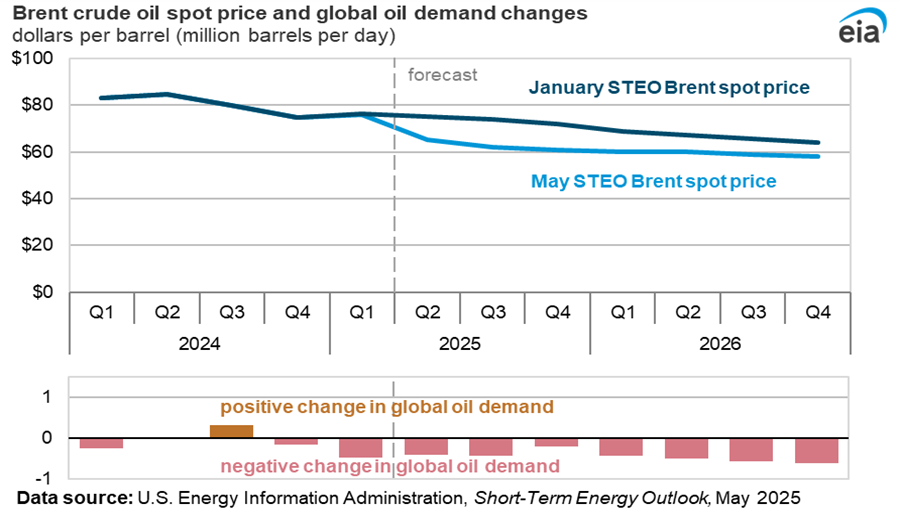
As the conflict persists, we have adjusted our expectations around the duration of the disruption. We now assume that the Strait of Hormuz will remain effectively closed through late May, with flows slowly starting to resume in late May or early June. Even after flows resume, we expect it will take until late 2026 or early 2027 for most pre-conflict production and trade patterns to resume. However, we anticipate that some producers around the Persian Gulf will not see their production levels return to pre-conflict levels during the STEO forecast period.
Disrupted crude oil production volumes in the Middle East have increased since our last forecast. We assess that production shut-ins averaged 10.5 million barrels per day (b/d) in April, and we expect they will peak at nearly 10.8 million b/d in May as storage levels reach maximum limits requiring producers to shut in additional volumes. One of the factors driving our increased expectations of shut-in production is that we now forecast Iran will have to reduce production in part due to the U.S. blockade, which has curtailed Iran’s ability to export oil.
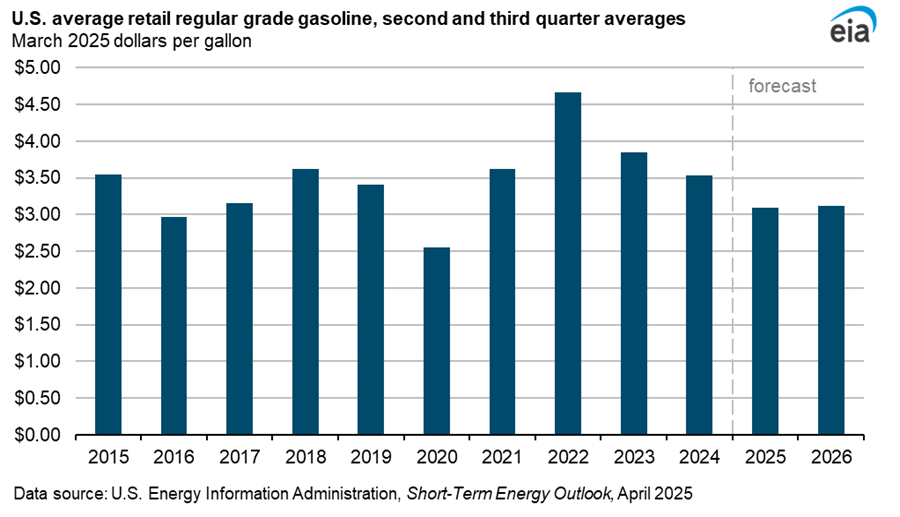
Making a long story shorter, without asking a bot to write a summarization - the war continues, the shortages worldwide continue, and despite the two highlighted projections, the Iran war may last longer than the NBA postseason. And then some. Ostensibly wanting a war's end, damn that nuke sticking point, the EIA estimate is Trump will not see a miracle economic rebound before the November vote.
But his friends in refinery ownership and operation will see fat-city continue, bless their profiting hearts.
It is confusing, in particular, should Trump negotiate in good faith into next year - presuming Iran will not compromise its asserted right to enrich uranium - he hangs to his script and hardships for voters will last beyond this year's election.
2028, how bright will things look for JD?
Trump says so many contradictory things that his lasting motives, should he have any, are beyond forecasting; indeed beyond sane understanding unless he's channeling Yeltsin's ghost, or some such.
And, maybe, Yeltsen's ghost is telling him to be true to those who put you in power, and weigh more the money US Big Oil put into his election, than lives lost and economic dislocations resulting from Bibi and The Donald thinking a jolly war might be fun. Who knows how Yeltsen's ghost might advise, but Boris was true to his along-the-way benefactors, or seemed to be.
_____________UPDATE____________
It should be mentioned, I did a duckduck search = since Feb 28, 2026, what volume of oil has been refined to date, and what was the incremental profiting over what the price per barrel Feb 1, 2026, had remained in effect
It's an interesting question, but I got no really helpful answer in the return list. But that's where I got the EIA items, and it explains the segue to the extensive quoting to show what petroleum truth at present is, domestically as to US interests, and worldwide. That part of the post is a bit inelastic and elastic together, so read it as seems best to you. It confuses me also.