 |
| Strib image. Crony NCAA? |
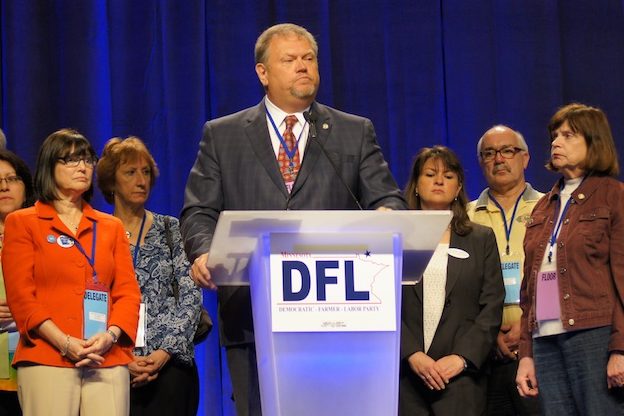
Nice seeming ladies. Big money.

|
| Strib image. Crony NCAA? |
Equally frustrating for the Democrats I spoke to is that this is not at all the case for House Republicans. Unlike Democrats, for example, Republicans term-limit their committee chairmen, making it possible for young and talented members to take over powerful committees early in their tenure. As Murphy, the former representative, pointed out, Paul Ryan is a good case study in the benefits of this policy: Ryan was only 41 when he took over the Budget Committee, a position that allowed him to build a national profile and attract attention from party leaders. Less than five years later, he gaveled in as speaker of the House.
“The Republican rules when it comes to term limits for chairmen is just how we view leadership,” National Republican Congressional Committee (NRCC) Spokesman Matt Gorman told me. “It encourages younger members to step up so we don’t see the stagnation we’ve seen on the other side.”

The Buffalo News first reported Higgins’ reversal on Pelosi. Just days before, Higgins had signed onto a letter opposing her, and he told POLITICO repeatedly in an interview that he wouldn’t back Pelosi “under any circumstances.”
But Pelosi is winning now, so circumstances apparently have changed enough for Higgins to reconsider his recent fervent opposition to her.
“For years, Congressman Higgins has been an extraordinary leader on the issue of achieving quality, affordable health care for all Americans. His Medicare buy-in proposal is central to this debate, as we work to build on the Affordable Care Act,” Pelosi said in a statement released shortly after news of Higgins' volte-face.
“We are looking forward to working together to lower the cost of health care for hard-working families and raise their paychecks by building infrastructure of America, which is also an important issue to Congressman Higgins.”
Higgins is the latest Pelosi critic to make a dramatic change in direction.
[... D]evelopments buoyed Pelosi as she fights to repel a small group of dissidents inside the Democratic caucus who want to force a leadership shake-up after 16 years with the Californian at the helm.
One was Rep. Marcia L. Fudge (D-Ohio), who left Washington last week planning to take the Thanksgiving holiday to ponder a run against Pelosi for speaker. But her dalliance ended Tuesday. Fudge said she would support Pelosi after the minority leader agreed to make Fudge chairman of a resurrected subcommittee on elections and pledged that “the most loyal voting bloc in the Democratic Party, black women, will have a seat at the decision-making table.”
“I am now confident that we will move forward together,” Fudge said in a statement. “I now join my colleagues in support of the leadership team of Pelosi, Hoyer and Clyburn.”
Increasing the minimum wage to $15 an hour and indexing it to median wage growth thereafter. The current federal minimum wage of $7.25 an hour is a starvation wage that must be increased to a living wage — at least $15 an hour. This would give more than 40 million Americans a raise and would generate more than $100 billion in higher wages throughout the country.
A path toward Medicare-for-all. The Medicare-for-all bill widely supported in the Senate has a four-year phase-in period on the way to guaranteeing health care for every man, woman and child. Over the first year, it would lower the Medicare eligibility age from 65 to 55, cover dental, hearing and vision care for seniors, provide health care to every young person in the United States and lower the cost of prescription drugs.
Bold action to combat climate change. The report from the Intergovernmental Panel on Climate Change has made it clear we have just 12 years to substantially cut the amount of carbon in our atmosphere, or our planet will suffer irreversible damage. Congress must pass legislation that shifts our energy system away from fossil fuels and toward energy efficiency and renewable energy. We can lead the planet in combating climate change and, in the process, create millions of good paying jobs.
Fixing our broken criminal-justice system. We must end the absurdity of the United States having more people in jail than any other country on Earth. We must invest in jobs and education for our young people, not more jails and incarceration.
Comprehensive immigration reform. The American people want to protect the young people in the Deferred Action for Childhood Arrivals program and to move toward comprehensive immigration reform for the more than 11 million people in our country who are undocumented. And that’s exactly what we should do.
Progressive tax reform. At a time of massive and growing inequality in both income and wealth, Congress must pass legislation which requires wealthy people and large corporations to begin paying their fair share of taxes. It is unacceptable that there are large, extremely profitable corporations in this country that do not pay a nickel in federal income taxes.
A $1 trillion infrastructure plan. Every day, Americans drive to work on potholed roads and crumbling bridges, and ride in overcrowded buses and subways. Children struggle to concentrate in overcrowded classrooms. Workers are unable to find affordable housing. The structures that most Americans don’t see are also in disrepair — from spotty broadband and an outdated electric grid, to toxic drinking water and dilapidated levees and dams. Congress should pass a $1 trillion infrastructure plan to address these needs while creating up to 15 million good-paying jobs in the process.
Lowering the price of prescription drugs. Americans pay, by far, the highest prices in the world for prescription drugs because, unlike other countries, the United States doesn’t directly regulate the price of medicine. The House should pass legislation to require Medicare to negotiate for lower drug prices and allow patients, pharmacists and wholesalers to purchase low-cost prescription drugs from Canada and other countries. It should also pass legislation to make sure that Americans don’t pay more for prescription drugs than citizens do in other major countries.
Making public colleges and universities tuition-free and substantially reducing student debt. In a highly competitive global economy, we must have the best-educated workers in the world. Every young person in America, regardless of income, must have the opportunity to receive the education they need to get a decent job and make it into the middle class. The House should pass the College for All Act to make public colleges and universities tuition-free and substantially reduce student debt.
Expanding Social Security. When 1 out of 5 seniors is trying to get by on less than $13,500 a year, we must expand Social Security so that every American can retire with dignity and security. The House should pass legislation to expand Social Security benefits and extend its solvency for the next 60 years by requiring that the wealthiest Americans — those making more than $250,000 a year — pay their fair share of Social Security taxes.
The Thanksgiving op-ed from Sanders comes a week before the independent senator will deliver the keynote address at a "gathering" of national and international progressive leaders in his home state of Vermont.
The event, coordinated by The Sanders Institute, founded by Jane Sanders, "will convene 250 leading progressive minds to envision – and to actualize – a better future for our country and the world. Reaching across generations and embracing the inherent synergies across the progressive platform, participants will discuss and debate our nation’s most pressing issues and offer innovative solutions."
Set in Burlington Vermont, the core intent of the Sanders Institute Gathering is to share replicable policies, develop actionable steps, establish ongoing networks and articulate a progressive vision.
About the event
THE GATHERING
BURLINGTON, VT + November 29 - December 1, 2018
Economic, environmental, racial and social justice issues will be threaded throughout the conference as we discuss the climate crisis, healthcare, housing, democracy, foreign policy, criminal justice, labor issues and more.
The Gathering is an informative, issue-oriented, idea-focused, movement-building conference focused on developing bold, progressive solutions. Following the event, we will be sharing the speeches, interviews, conversations and sessions in a variety of formats.
 |
| Image from independent story, here. |
By John Solomon, opinion contributor — 10/01/18 05:45 PM EDT The views expressed by contributors are their own and not the view of The Hill
On June 29, 2010 Renaissance Capital, a Russian investment bank with ties to the Kremlin and which was promoting Uranium One stock, paid Bill Clinton $500,000 for a speech in Moscow shortly after the Rosatom acquisition of Uranium One was announced.[14][15]
[footnoted text, linking omitted]
14. Becker, Jo; McIntire, Mike (April 23, 2015). "Cash Flowed to Clinton Foundation Amid Russian Uranium Deal". The New York Times.
15. Campbell, Colin; Engel, Pamela (April 23, 2015). "The Clinton Foundation received millions from investors as Putin took over 20% of US uranium deposits". Yahoo! Finance. Retrieved August 31, 2016.
Here is a list of 11 questionable items forming a chain of events:
1. September of 2005: Canadian Frank Giustra visits Kazakhstan with Bill Clinton. Days later, his company UrAsia wins a major uranium deal with the country.
2. 2006: Giustra donates $31 million to the Clinton Foundation.
3. February 2007: UrAsia merges with Uranium One and expands into the U.S..
4. June 2008: Russian atomic agency Rosatom begins talks to acquire Uranium One.
5. 2008 to 2010: Uranium One and UrAsia investors donate $8.65 million to Clinton Foundation.
6. June 2009: Rosatom acquires 17% of Uranium One.
7. 2010 to 2011: Millions more donated by Uranium One investors to Clinton Foundation.
8. June 2010: Rosatom requests Committee on Foreign Investment (of which the State Department is a member and its approval is needed) to approve a majority ownership in Uranium One, PROMISING NOT TO PURCHASE 100% of it, NOR TAKE IT PRIVATE.
9. June 2010: Bill Clinton receives $500,000 to speak at a conference held by the Russian investment bank involved in the Rosatom transactions.
10. October 2010: Committee APPROVES Rosatom's request to ACQUIRE A MAJORITY SHARE in Uranium One.
11. January 2013: Rosatom PURCHASES REMAINDER of Uranium One and takes it PRIVATE!.