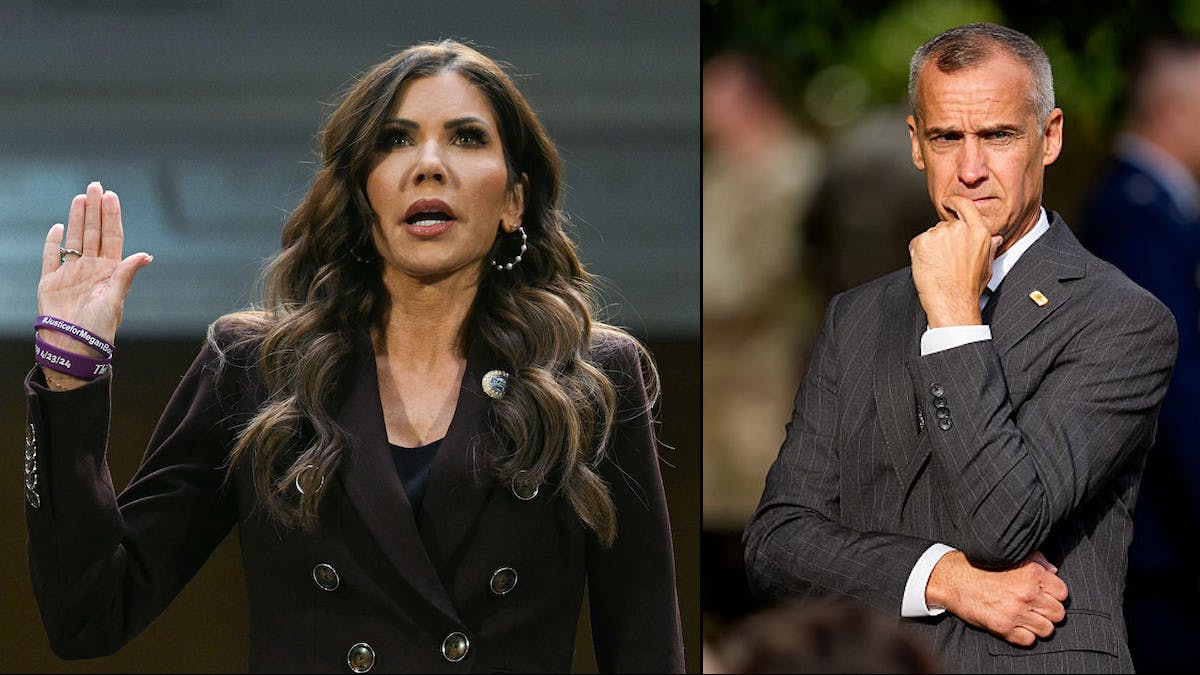
The reporting does overlap. But the even is of major import. It is a chance to add a presence in the streets, or on sidewalks, to say, "No Kings" With somebody particular in mind, unnamed here for now, but guess.
The officers were originally on a one-star promotion list of about three dozen officers consisting mostly of white men, The New York Timesreported Friday.
Hegseth
had been pushing Army Secretary Daniel Driscoll to remove the four
officers for months, but given their years of exemplary service,
Driscoll refused, military officials told the Times. Hegseth finally removed their names himself, likely without the legal authority to do so.
As
per military policy, the defense secretary is technically only supposed
to approve or reject the entire list to prevent discrimination and
prejudice—two things the former Fox News host has embraced in his
catastrophic stint as defense secretary.
Since he was appointed in January 2025, Hegseth has gutted diversity, equity, and inclusion policies, pledged to remove women officers from combat, and banned
trans people from serving in the military. “For too long, we’ve
promoted too many uniform leaders for the wrong reasons—based on their
race, based on gender quotas, based on historic so-called firsts,” he
said in a speech last November.
A
similar feud over race happened last summer when Maj. Gen. Antoinette
R. Gant was selected to command the Military District of Washington.
Hegseth’s chief of staff, Ricky Buria, was furious. He told Driscoll
that Trump would not want to stand next to a Black female officer at
military events, the Times reported.
Trump and Hegseth are twin sons of different mothers. In 2028 we'll need a broom wide enough to sweep out both, and then, one whole of a hell of a lot more.
Sanitization. And who knows, possibly some cash clawback.
So, within that context, and in a who-do-you-trust mood, this.
Think of Peter Thiel as the man who bankrolled JD Vance into the mainstream. (With a bit of help but not really much from JD being his charming and compelling self.)
Polymarket gained mainstream popularity during the 2024 US
presidential election, but it has become synonymous with suspected
insider trading since January after well-timed bets on US plans to abduct Venezuelan President Nicolas Maduro, followed by the start of the war on Iran two months later.
Researchers
have tracked dozens of examples of anonymous new accounts betting big
but also correctly just before a critical event like the February 28
US-Israeli strikes that began the Iran war.
As of
Wednesday, there were 355 live prediction markets on Polymarket linked
to outcomes in the war, such as the identity of the next leader of Iran,
the date of a US-Iran nuclear deal and when Iran will launch military
action against Israel.
The independent on-chain analyst
known as Andrew 10 GWEI told Al Jazeera one of the most “striking”
recent examples of suspicious betting was his discovery of 38 accounts
that he believes belong to one person and netted more than $2m betting
correctly on the February 28 strikes.
Each of the
accounts placed from four to 10 bets with a nearly 100 percent success
rate, according to research Andrew shared on X. Also noteworthy was the
fact that the user began preparing accounts with cryptocurrency
transfers on February 22 before bets were placed on February 27 between
11:00 and 12:00 GMT on the chance of a February 28 strike.To continue, please allow functional cookies from third-party platforms.
Red flags
While successful Polymarket bets could be based on everything from open-source intelligence to simple beginners’ luck, researchers look for several red flags that suggest suspicious betting.
[...] ] Fintech platforms have not been
the only source of suspicious betting over the past week as a series of
well-timed Wall Street trades have also raised eyebrows and questions
of possible insider trading.
The recent round of
questionable trades all occurred early on Monday before the markets
opened in the US and Trump announced on his Truth Social platform at
7:04am (11:04 GMT) that he was going to delay threatened attacks on
Iranian energy infrastructure after “VERY GOOD AND PRODUCTIVE
CONVERSATIONS” with Tehran.
In the 15 minutes before
the announcement, trading spiked as 6,200 Brent crude and West Texas
intermediate oil contracts with a notational value of $580m were
exchanged, according to Bloomberg data.
[...] After
Trump’s news on Monday, the price of Brent crude oil fell sharply from
$112 a barrel to about $99 while West Texas intermediate fell from about
$99 to $86, netting a small fortune for anyone who bet big on a price
drop.
At the same time, pretrading volume on the
S&P 500 e-Mini, which trades on the future performance of the
S&P 500, surged about 6:50 am (10:50 GMT) on the Chicago Mercantile
Exchange.
As an index of the 500 largest publicly
traded companies in the US, the S&P 500 is regarded as a bellwether
for the US economy and often responds to major news events, including
Trump’s announcement.
‘Exploit information for profit’
Unusual
Whales, a platform that tracks unusual activity from large or
influential investors known as “whales”, reported that one trade
involved buying S&P 500 futures with a notational value of $1.5bn
and selling oil futures with a value of $192m.
“These
orders were 4-6x larger than anything else at the time. The trader
seemingly made huge gains,” Unusual Whales wrote in a post on X.
Spikes
were also seen on other futures markets like the DAX Index Futures and
Euro Stoxx 50 Index and across the Nasdaq and Russell 2000 Indexes,
according to Bloomberg.
Observers said this kind of
activity was highly unusual because it happened before the market opened
on Monday and on a day without an anticipated news hook, such as the
release of critical US economic data or a company earnings call.
Independent
commodities trader Peter Brandt told Al Jazeera that he found the
timing of the trades suspicious among other large, recent
“market-shaking announcements”.
“I’ve traded long
enough [five decades] to know, where there is smoke, there is usually
fire,” Brandt said, adding that the trades were nevertheless legal
because there is no law in the US against “this type of insider trading”
of futures contracts for oil and the S&P 500.
US
economist and Nobel laureate Paul Krugman took a much harsher view,
writing on Substack that there was an “obvious explanation” to Monday’s
otherwise “baffling” trades.
[...] The White House did not immediately respond
to Al Jazeera’s request for comment, but a White House spokesperson told
the Financial Times this week that it does not “tolerate any
administration official illegally profiteering off of insider knowledge”
and accusations of insider trading were “baseless and irresponsible
reporting”.
‘Insider trading’
Amid
the growing scrutiny of recent trades on Iran-based news, members of
the Democratic Party have called for more regulation of prediction sites
like Polymarket.
Democratic Senator Chris Murphy, who
has accused officials in Trump’s Republican administration of “insider
trading” on Iran war news, last week introduced the Banning Event
Trading on Sensitive Operations and Federal Functions (BETS OFF) Act in
Congress.
The
BETS OFF Act would prohibit platforms like Polymarket and its
competitor Kalshi from allowing bets on “government actions, terrorism,
war, assassination, and events where an individual knows or controls the
outcome”.
In the short term, both Polymarket and Kalshi moved to address questions of insider trading this week.
If we are to take Trump at his word, even if a BETS OFF Act were to pass both chambers, he would not sign it before getting, if ever, his voter-screwing FACT Act on his desk. Then, of course, he'd sign it since neither Jarad, the offspring, himself, or Cabinet folks would stoop to insider trading for self enrichment. Nor would Stephen Miller. Or his spouse. We can have that kind and degree of trust in our leadership.
JD would not insider trade either. They taught him it was a no-no at Yale. The US of A is so fortunate to have the degree of rectitude DC shows the world, Trump on downward. And it has oil giants too. What luck.
“Leave
a Future” is the University of Minnesota’s first new tagline in 20
years. People aren’t quite sure what it means, or what to think of it. By Eleanor Hildebrandt and Zoë Jackson - The Minnesota Star Tribune - March 19, 2026 at 6:26PM
The story is paywalled, but basically the slogan had been "Driven to Discover" which is something a university would be expected to say.
"Leave a Future" makes me think of putting a baby onto somebody's doorstep, ringing the bell and getting out of sight before the door opens.
But, that's me.
Strib noted the U Foundation and the U somehow splitting costs apparently have used the firm "Rise and Shine Partners" for marketing services - no shit, "Rise and Shine." Slogan specialists, apparently. A brief early paragraphs excerpt -
Officials from the U were unavailable to comment for this story. The U’s foundation, which paid for the majority of $15 million contract
with marketing firm Rise and Shine and Partners to help the U with
branding over five years, also did not respond to a request for comment.
Rise and Shine and Partners said it could not comment on active work.
At a March 6 meeting where U staff unveiled the new slogan,
Susan Hagen, the U’s director of creative services, said the tagline is
about evolving the university’s brand to prioritize education and
service alongside research. She said research showed that the community
wanted to “expand beyond a hard focus into just research.”
Hagen said the university’s branding needs “to be a little less Minnesota humble and a little more bold and proud.”
Susan Hagan is made by that multi-paragraph text to look like a skilled bullshitter, so rise and shine that thought for a while. Or whatever. More bold and proud? Huh?
"Pay your library fines" could also be a fine university slogan, for any university.
But leaving a future seems to mix tenses strangely, as Strib noted a student saying.
But back to my impression, that doorstoop baby is a future, and being left completes the thought. Tell me I am wrong.
"Get serious once you get here," is another good university slogan for any student not having gold family connections, where that golden family offspring can get by on "C" grade point average and do well as a graduate. Trump's son in law got through exHarvard after all, so perhaps Harvard should have a marketing slogan,"The Endowment Gains a Future." Who knows.
Another slogan and leave it there, "Not Animal House." That indirectly suggests either a step better or worse in administrative chops than the fictional institution.
"Pay Tuition" seems too harsh. It's not about cash flow, is it?
To the extent slogan formation is like headlining, the Strib headline did sluff over the Rise and Shine people doing marketing services over five years, getting fifteen million over time, not for a one shot "Leave a Future" thing, and the clarification in the story arguably left the fleshing out bit too late in the story. Headlining 101 lore is do not misimpress, but hook the reader by ambiguity, such as,"The Iranians have shown multiple options after the first bomb dropped." A headline like that, the reader wonders, what "options?" You suck the reader into the story.
This Strib headline gets the reader wondering, "What Internet thoughts?" It does work that way. Actually, "The Internet HAS Thoughts," would work as a headline for this blog, as in where do you go with a tagline like that? What "Thoughts?"
The upshot appears the US coordinated planning with Israel, but possibly at a level where it never reached Trump before the event that planning that way existed. Roosevelt did not know all Eisenhower and the Generals planned during US participation in WW II. But the gas field was a big escalation.
From that, neither Israel nor the US will attack the gas resources unless Iran further attacks Qatar's. A standoff.
Trump may be lying. It would fit his past statements, where trustworthiness hangs.
However, Fed policymakers still expect to cut their key rate once in 2026.
For now, they left short-term interest rates unchanged for the second straight meeting
at about 3.6%. In a statement Wednesday, the central bank said that the
“implications of developments in the Middle East for the U.S. economy
are uncertain.”
Still, by keeping their forecast for a rate cut
this year and next — the same projections that they made in December —
central bank policymakers appear to expect the gas price spike from the
Iran war to have a largely temporary effect on inflation and the
economy. Policymakers also foresee unemployment remaining unchanged by
the end of this year, a more optimistic outlook than most outside
economists.
Whether that turns out to be true will largely depend
on the length of the conflict. The officials expect inflation to fall
back to 2.2% in 2027 and hit the Fed’s 2% target in 2028.
Fed
officials now expect that inflation will be 2.7% at the end of this
year, up from their December forecast but slightly below the 2.8% it
reached in January. They expect core inflation, which excludes the
volatile food and energy categories, to also finish the year at 2.7%, up
from a previous forecast of 2.5%. The Fed considers core prices a
better measure of longer-run inflation. Consumer prices will spike
higher in the coming months as gas prices have soared, but those
increases could unwind by the end of the year, particularly if the
conflict ends soon.
The Iran war has dealt a massive energy shock to the global economy
by choking off exports of crude oil and liquefied natural gas through
the Strait of Hormuz. Iran has also attacked key export facilities in
its Gulf neighbors, putting more upward pressure on energy prices, even
though Gulf neighbors Saudi Arabia, Qatar, Oman, Iraq and the United
Arab Emirates are not taking part in the US-Israeli attacks on Iran.
In
the case of South Pars, the energy shock would appear to have a
different target: not Iran’s exports, but its biggest source of domestic
energy supplies in a country that sometimes struggles to product enough
electricity.
Here are key things to know about the South Pars field and the impact of the attack:
Iran uses a lot of natural gas, and 80% comes from South Pars
Iran
relies heavily on gas to produce electricity and heat homes. It is the
fourth-largest consumer of natural gas in the world, behind the US,
China and Russia, according to the Center on Global Energy Policy at
Columbia University, even though its economy is much smaller, In
contrast to other Middle East countries, it uses gas for heating due to
its cold climate and much of that use is subsidized, which discourages
efficient use. South Pars is the main source.
UPDATE: Iran's former uranium enrichment negotiating team has not been seen online by Crabgrass to have yet suffered loss of life after the lead negotiator, Iran's Foreign Minister, declared the time for talks being over immediately after start of the war. Possibly there was targeting that failed, or a death went unreported, but aside from the foreign minister the other negotiation team members likely are not highly placed or influential government officials. Iran appears to have a diverse and inclusive government membership to where governing can continue even with the selective Israeli human strikes.
It appears the Israelis have a priority structure of some kind for their killing strikes, and either the US greenlights some Israeli choices or Israel acts wholly independent of US aims or constraints.
Each belligerent has seemed to do separate targeting. With the US concentrating upon difficult or hardened targets of the Iranian military, while Israel includes government officials in its attacks; something which the US appears not to do.
There is confusion. Gary Gross, with a NYPost link, publishes a suggestion that Iran's passage permissions may be wider than aJ-Eng reports, aJ publishing16 Mar 2026:
Iranian Foreign Minister Abbas Araghchi told the US television
network CBS on Sunday that Tehran had been “approached by a number of
countries” seeking safe passage for their vessels “and this is up to our
military to decide.” He added that a group of vessels from “different
countries” had been allowed to pass, without providing details.
Here
is what we know about which countries’ ships are being allowed to pass
through the strait and which nations are reported to be negotiating for
safe passage.
Pakistan
A Pakistani-flagged
Aframax tanker called Karachi sailed out of the Gulf through the Strait
of Hormuz on Sunday, Bloomberg News reported.
India
On
Saturday, Iran’s ambassador to India, Mohammad Fathali, said Tehran
had allowed some Indian vessels to pass through the Strait of Hormuz in a
rare exception to the blockade that has disrupted global energy
supplies.
Fathali did not confirm the number of vessels. However,
on the same day, New Delhi said two Indian-flagged tankers carrying
liquefied petroleum gas bound for ports in western India had passed
through the strait.
“They
crossed the Strait of Hormuz early morning safely and are en route to
India,” Rajesh Kumar Sinha, special secretary of the Ministry of Ports,
Shipping and Waterways, said at a news briefing in New Delhi.
Turkiye
A
Turkish-owned ship that had been waiting near Iran was allowed to pass
through the strait after authorities received permission from Tehran,
Turkish Transport and Infrastructure Minister Abdulkadir Uraloglu said
in comments to Turkish media on Friday.
“Fifteen ships [with
Turkish owners] were there. We obtained permission from the Iranian
authorities for one of them that had used an Iranian port, and it
passed,” Uraloglu said.
China
China is in talks
with Iran to allow crude oil and Qatari liquified natural gas carriers
safe passage through the Strait of Hormuz, the Reuters news agency
reported on March 5, quoting three unnamed diplomatic sources.
China,
which has friendly relations with Iran and relies heavily on Middle
Eastern petroleum supplies, is unhappy about Iran’s decision to paralyse
shipping through the strait and is pressing Tehran to allow safe
passage for its vessels, according to the sources.
China receives 45 percent of its oil via the Strait of Hormuz.
France and Italy
The
two European nations are understood to have requested talks with Iran
about allowing their ships to pass through the strait, the UK’s
Financial Times has reported, citing unnamed officials.
All the Arab Gulf states are unlisted. Crabgrass trusts aJ-English more than NYPost, because it is owned by an Arab Gluf state, which would know whether it's tanker ships passed; and because NYPost is a Murdoch outlet and hence biased and intentionally unreliable. aJ-Eng also posts extensively of Qeshm, the Iranian island inside the Straits, along the Iranian mainland; the report stating:
Beneath the labyrinthine salt caves and emerald mangrove forests of Qeshm Island in the Strait of Hormuz, a different kind of architecture lies buried.
[...]
‘Missile cities’ – the fortress in the strait
Today,
the island’s modern industrial facade, bolstered by its status as a
free trade-industrial zone since 1989, is overshadowed by its role as
Iran’s “unsinkable aircraft carrier”.
Located just 22km (14 miles)
south of the port city of Bandar Abbas, Qeshm dominates the Clarence
Strait, also known as Kuran, and acts as the primary platform for Iran’s
“asymmetric” naval power, say analysts.
While exact figures regarding the number of Iranian fast-attack boats
and coastal batteries hidden within the island’s subterranean
labyrinths remain heavily classified, their strategic intent is clear.
Retired Lebanese Brigadier-General Hassan Jouni, a military and
strategic expert, told Al Jazeera that Qeshm houses “striking Iranian
capabilities” within what is described as an underground “missile city”.
These vast networks, Jouni said, are designed for one primary purpose:
to effectively control or close the Strait of Hormuz.
This, they
have successfully done. Shipping traffic through the strait was
effectively halted last week when Iran threatened to strike ships
attempting to pass.
Now, only a handful of ships
carrying vital oil and gas supplies to the rest of the world are being
allowed through, as countries scramble to negotiate deals with Iran for
their own tankers and as the administration of United States President
Donald Trump attempts to assemble a naval convoy of warships to forcibly open the waterway.
As
Qeshm becomes the focal point of a 21st-century energy war, however,
its silent salt caves and ancient shrines serve as a reminder that while
past empires and military coalitions like those of the Portuguese and
British have eventually faded, the geological fortress of the strait
remains anchored in the turbulent tides of history.
[...]
Apart from the question of tanker passage through the Straits, much of Gary's post deals with Kharg Island, well to the north of the straits, where US bombing destroyed military targets while leaving Iran's critical Kharg oil depot infrastructure intact - for the time being.
____________UPDATE___________
Apart from any firepower Iran
has on Qeshm itself or on adjacent Iranian mainland, aJ-Eng publishes of
remaining firepower of Iran in general, as of Mar 16, 2026:
That item reports "Hours ago, U.S. forces successfully employed multiple 5,000-pound deep penetrator munitions on hardened Iranian missile sites along Iran’s coastline near the Strait of Hormuz." Dated: Mar 17, 2026 5:45 pm
Such Centcom news is of great import on the question of tanker passage through the Straits. Crabgrass has seen no follow-up reporting online.
They talk of one thing, in text, and post with it video that is not in parallel.
There is a war going on, but what do the station's ownership and editors want to say, what exactly?
We presently in the States see reporting by domestic established outlets which says little about what's actually happening, why with total air control no Trump effort is being made, no Bibi effort either, to simply blast through the Straits of Hormuz so that Chaina can get its oil from multiple sources, while, apparently, Iran lets some tankers through but threatens others.
What precisely is the US policy objective at this point in a situation publicly presented as not a "forever war?"
Put another way, you tell me, what is the primary US objective in doing what it is doing as it is doing it?
Those interspersed video clips aJ puts into seemingly random points in a text about AIPAC in Chicago are more open to speculation - why those, not others - than the linear story of the text. It interests us, or should.
UPDATE: An intrigue exists around "regime change." Trump adamantly denied the conflict is about that, so that fuels speculation that regime change is the whole point, given how Trump lies and the administration he heads is not super-informative either.
And if "regime change" is some form of ultimate objective, 4 or 5 weeks from the air - as Trump has forecast things lasting - is wholly unreasonable and beyond sane belief.
Wha's 'appening? MSM images of tight bombing patterns do not explain much at all.
FURTHER: DuckDuckGo search, using the LLM = GPT-4o mini tells me:
We have aJ-English reporting Trump, after the war began, projected a belief the war would end soon. This was after phone conversations with Putin. However, Iranian reaction was reported by CBS March 15, 2026:
Iranian Foreign Minister Abbas Araghchi said Sunday that "we don't
see any reason why we should talk with Americans" as President Trump has
claimed Iran is seeking a deal to end the war between the U.S. and Iran.
As
the war entered its third week, Mr. Trump has claimed in recent days
that Iran wants to reach a deal. The president said in a post
on Truth Social late Friday that Iran "is totally defeated and wants a
deal - But not a deal that I would accept!" On Saturday, he told NBC News that "Iran wants to make a deal, and I don't want to make it because the terms aren't good enough yet."
But
Araghchi said "we are ready to defend ourselves as long as it takes,"
saying "this is what we have done so far, and we continue to do that
until President Trump comes to the point that this is an illegal war
with no victory."
"There are, you know, people being killed only
because President Trump wants to have fun," Araghchi said. "This is a
war of choice by President Trump and the United States, and we are going
to continue our self defense."
The Iranian foreign minister
refuted the idea that the conflict represents a war of survival for
Iran's government, saying "we are, you know, stable and strong enough."
He said the Iranian government doesn't see "any reason" why it should
negotiate with the U.S., pointing to the talks that were taking place
before the U.S. and Israel launched the initial strikes on Iran late
last month.
"We were talking with them when they decided to
attack us, and that was for the second time," he said. "There is no good
experience talking with the Americans. We were talking, so why they
decided to attack us? So what is good if we go back to talk once again?"
Mr. Trump on Sunday night said the U.S. has been in communication
with the Iranians. "Yeah, we're talking to them," Mr. Trump said, "but I
don't think they're ready. But they're getting pretty close."
WASHINGTON, March 16
(Reuters) - Iranian Foreign Minister Abbas Araqchi said on Monday that
his last contact with U.S. envoy Steve Witkoff was before the U.S. and
Israel launched their war on Iran, contradicting an earlier media
report that a direct communications channel between the two men was
reactivated in recent days.
"My
last contact with Mr. Witkoff was prior to his employer's decision to
kill diplomacy with another illegal military attack on Iran," the
Iranian foreign minister wrote on X.
"Any claim to the contrary appears geared solely to mislead oil traders and the public."
Axios
reported that a direct communications channel between Witkoff and
Araqchi was reactivated in recent days. The report cited a U.S.
official and a source with knowledge of the matter, who said Araqchi had
sent text messages to Witkoff.
The
Drop Site News outlet had earlier reported that Witkoff sent messages
to Araqchi. It quoted Iranian officials as saying Araqchi was ignoring
Witkoff's messages.
So, while others on the Iranian negotiating team in Geneva seem lesser figures who go unreported, we know Aragchi is still alive, and not having perished under recent Israeli strikes.
He appears in alignment with hardliners in control now in Iran despite the recent strikes, and it seems possible harder hardliners may take power as others are killed.
If having a hope of regime change, from air power, some Iranian people or a bloc would have to come forward or be discovered to be an amenable new regime, as the field of possible candidates gets winnowed via snuffing by the Israelis.
We, the public of the US paying attention to media reporting may be getting mushroomed on this whole thing. As likely as not.
BOTTOM LINE: Regime change can happen only if there are Iranians who'd be able to handle it. The son-of-Shah thing going on the US seems a dream. Shah was despised so much that a mullah in exile in France could in 1979 arrive and take power. That was a power vacuum bigger than the one now in Iran, or seems so.
It speaks for itself, and expresses a more favorable view of Peggy Flanagan over Craig as the other candidate for the open seat; an opinion Crabgrass shares.
A likely scenario would be Flanagan winning the primary despite Craig having tons more money to invest in the Craig candicacy; Amy winning Gov., and appointing Craig to the balance of the then vacated Amy seat. Both into the Senate that way.
I have a worry about Craig which is fleshed out by https://www.trackaipac.com/congress at its Minnesota Congressional membership segment. Only one other Rep or Senator has gotten more AIPAC money than Craig, that being Republican Emmer.
Republican House wip, Emmer PAC money = $784,132, Craig PAC money = $655,825 with both Senators having lower PAC figures then those two Reps. Total Israel lobby money, PAC included(?), same story but a reversal, Emmer = $1,200,356 - all Israel lobby sources, Craig = $2,613,266 - all Israel lobby sources; (Klobuchar ringing in atop all sources = $2,681,048). That worries me. One can check the detail, again, https://www.trackaipac.com/congress. For some reason, AIPAC is not required to register as an agent of a foreign government, under the statute that got Gen. Flynn hung out to dry. It's unfortunately inexact, but the numbers are sufficient to say Craig is getting a ton of campaign cash from Israel related interests, quibble where you may over one or a different source and its status.
Not liking the Bibi regime and its Gaza ethnic cleansing, that worries me. Not liking Zionism as a cause to confiscate land of others, and not liking a Greater Israel from the Med. to both sides of the Jordan, an ultimate goal of some, while in turn liking the Two State solution Bibi pisses on, I have reservations over Craig.
Flanagan is a progressive with Bernie and Liz Warren's endorsement. No contest.
But expect Craig to be the Klobuchar replacement in the Senate when Amy wins Governor. That's a bet I'd make with anybody, Amy the candidate after the primary, Amy the winner against some GOP stiff. Craig getting Amy's nod.
Not a progressive's dream, but as stated previously, Craig is honest and competent and a better candidate than others who might be suggested. Not ideal, but okay.
______________UPDATE_____________
AIPAC is itself, warts and all, but it is at the same time hiding from itself. Surely it will visit Congressional seat winners to say, "Remember when you needed money backing your candicacy," but when backing, now, they use subterfuge.
It is shabby. It is AIPAC. They are anti-progressive.
Their candidates are not my candidates. May Peggy Flanagan trounce Angie Craig in Minnesota's primary, first because Flanagan is the progressive in the contest, but also because AIPAC has a bad taste, even when hiding whose money is being pumped toward a candicate's chances.
Again, Craig likely will be into the second seat, once vacated by a successful campaign for Governor, but it is very important that Flanagan trounce Craig because progressives are better fit to win and govern well as the people want.
Craig is a conservative. Not a Republican, but a conservative. That ilk is less in tune with what poll after poll shows regular people by subsrtantial majorities prefer.
So, Craig is conservative - in that DFL camp, and takes AIPAC assistance.
But with two frontrunners and a great likelihood of two Minnesota Senate seats being available after November election results are counted, it is a symbolic victory Flanagan is likely to gain, with Craig being her likely Senate companion, as both move with a hoped for Dem Senate post-election majority in both Houses so that schmucks like Mike Johnson, Stauber and Tom Emmer are put into the place best for them. The minority.
Opinions shall differ, but hopes are as they are. Craig will do okay.
But do not loose site of how really odious AIPAC and its leadership are. Supporting war crimes and war criminal ultra-Zionists and their guns and aircraft and aparthied.
I have been told that Angie Craig is amenable to the Two State Solution, but not by Craig herself. Most sensible people support two states as ultimately best.
_____________FURTHER UPDATE___________
While in a Crabgrass defined perfect world, Amy would win and Flanagan would win, and then Amy would appoint Al Franken back into his Senate persona, indirectly telling K. Gillibrand to shove it up her me-too.
Not likely, but when you say perfect world, Al would be better than Angie. Brighter and more progressive. It may already be precast in concrete at the inner party level that one wins, the other gets the vacated new Governor's former place. But I really prefer Al.Gillibrand deserves it.
Not chump change, so what has it bought? And, from whom? The second item is subheadlined -
The DHS secretary decided the contracts instead of allowing a
competitive bidding process, according to three administration officials
and internal communications reviewed by NBC News.
Tattletales they used to be called, now "whistleblower" is a favored term. Either way, absent such alert moral individuals, or folks with an ax to grind, things can go unseen and unremediated.
Because of the higher dollar amount, the $220M item first:
The Department of Homeland Security Office of Inspector General has for
more than a month been investigating the process in which three
businesses received $220 million for an ad campaign encouraging illegal
immigrants to self-deport and featuring outgoing Secretary of Homeland
Security Kristi Noem, according to sources familiar with the probe.
[...] A source in the DHS community accused Noem of “retaliating” by not
allowing the IG to “work real cases” because she and her top adviser,
Corey Lewandowski, could be implicated in the watchdog probe of the ad
contracts.
The $220 million ad contract sparked bipartisan Senate scrutiny
during a Judiciary Committee hearing last week before Trump fired Noem,
who will leave her role by March 31. Trump, who has since openly
criticized the ad campaign’s price tag, tapped Oklahoma GOP Sen.
Markwayne Mullin to replace Noem.
Republican Sens. John Kennedy and Thom Tillis joined Sen. Peter
Welch, a Vermont Democrat, in questioning Noem about the ad campaign
contract and whether any DHS employee had financially benefited from it.
The senators repeatedly pressed Noem on why it was awarded to three
companies, including a subcontractor run by Ben Yoho, the husband of
former DHS press secretary Tricia McLaughlin.
Image - the spouses, McLaughlin and Yoho -- then continuing the excerpt
Ad maker Pat McCarthy, also of DMM Media, is best known for producing
Trump’s viral 2024 “They/Them” ad targeting then-Vice President Kamala
Harris’ support for transgender surgeries for California prisoners. MAGA
Inc., the super PAC that spent the most money supporting Trump’s 2024
campaign, hammered Harris in the ads, echoing a Trump campaign ad almost
exactly, saying, “Crazy liberal Kamala’s for they/them. President Trump
is for you.”
People Who Think is associated with Jay Connaughton, who worked with
Lewandowski on Jeff Landry’s Louisiana gubernatorial campaign.
[...] A spokesman for the DHS IG’s office said it could not confirm nor
deny the existence of any particular investigation. On its website,
however, the IG lists as one of its ongoing projects “an audit of grants
and contracts awarded by any means other than full and open competition
during fiscal year 2025,” which could perceivably include information
about the process in which DHS officials awarded the contracts for the
$220 million Noem ad campaign.
That audit, which is congressionally mandated to take place on a
yearly basis and apply oversight to all DHS grants and contracts, is
currently paused because the ongoing DHS government shutdown has forced
the watchdog agency to furlough employees assigned to it. One source,
however, said the DHS IG investigation into the Noem ad campaign in
question was separate from this audit.
Inspector General Joseph Cuffari in a letter to Congress sent last
week accused DHS leadership of having “systematically obstructed” his
work, including on a criminal investigation and another into the Secret
Service’s failures before and after the 2024 assassination attempt on
Trump’s life in Butler, Pennsylvania.
The item continues with detail of the obstruction assertion/rebuttal.
From the $100M MSN item:
Typically, multiple companies
are allowed to bid on a contract and officials who handle government
procurement — not the leaders of departments — decide based on who can
do the best job for the lowest price.
[...] In
August, then-ICE deputy chief of staff Madison Sheahan threatened the
job of an ICE employee for suggesting that the agency consider other
contractors, according to internal communications. Sheahan said the
contract award was “a decision made by the secretary,” according to
internal communications.
Sheahan
then called the employee to her office where he was yelled at for
overriding Noem by suggesting the contract go to a company that was
offering to do the work for a cheaper price, said an administration
official who heard the conversation. The employee then acquiesced and
agreed to award the contracts to the companies Noem chose, the three
administration officials said.
The campaign was rolled out in
the late fall and was aimed at hiring 10,000 new ICE officers by running
TV ads in select markets, visiting hiring events, as well as marketing
to gun owners and former members of the military.
In
a statement, a DHS spokesperson said, “Decisions about the ICE
recruitment campaign contract were made by the ICE Director’s office. [...]
But the three
administration officials said acting ICE Director Todd Lyons’ office was
not involved in choosing the contractors for the recruitment campaign
and maintained that the decision came from Noem.
The contract for the ICE
recruitment campaign was awarded to People Who Think and Safe America
Media, two firms that were previously awarded a $220 million ad campaign
that encouraged immigrants to self-deport.
Noem
was questioned by lawmakers this week over that $220 million ad
campaign, and her response incensed Trump, NBC News has reported.
“The
president approved ahead of time you spending $220 million running TV
ads across the country in which you are featured prominently?” Sen. John
Kennedy, R-La., asked Noem on Tuesday.
“Yes
sir, we went through the legal process,” Noem said. She went on to
confirm two more times that the president had knowledge of her decision.
Trump told Reuters on Thursday said he never signed off on the campaign and didn’t know anything about it.
It appears the questionable spending methods were first uncovered by ProPublica, source of the above image, publishing Nov 14, 2025:
Firm Tied to Kristi Noem Secretly Got Money From $220 Million DHS Ad Contracts
The company is run by the husband of Noem’s chief DHS spokesperson and
has personal and business ties to Noem and her aides. DHS invoked the
“emergency” at the border to skirt competitive bidding rules for the
taxpayer-funded campaign.
On Oct. 2, the second day of the government shutdown, Homeland
Security Secretary Kristi Noem arrived at Mount Rushmore to shoot a
television ad. Sitting on horseback in chaps and a cowboy hat, Noem
addressed the camera with a stern message for immigrants: “Break our
laws, we’ll punish you.”
Noem has hailed the more than $200 million, taxpayer-funded ad
campaign as a crucial tool to stem illegal immigration. Her agency
invoked the “national emergency” at the border as it awarded contracts
for the campaign, bypassing the normal competitive bidding process
designed to prevent waste and corruption.
The Department of Homeland Security has kept at least one beneficiary
of the nine-figure ad deal a secret, records and interviews show: a
Republican consulting firm with long-standing personal and business ties
to Noem and her senior aides at DHS. The company running the Mount
Rushmore shoot, called the Strategy Group, does not appear on public
documents about the contract. The main recipient listed on the contracts
is a mysterious Delaware company, which was created days before the
deal was finalized.
No firm has closer ties to Noem’s political operation than the
Strategy Group. It played a central role in her 2022 South Dakota
gubernatorial campaign. Corey Lewandowski, her top adviser at DHS, has
worked extensively with the firm. And the company’s CEO is married to
Noem’s chief spokesperson at DHS, Tricia McLaughlin.
The Strategy Group’s ad work is the first known example of money
flowing from Noem’s agency to businesses controlled by her allies and
friends.
Government contracting experts said the depth of the ties between DHS
leadership and the Strategy Group suggested major potential violations
of ethics rules.
[...] Federal regulations forbid conflicts of interest in contracting and
require that the process be conducted “with complete impartiality and
with preferential treatment for none.”
“It’s worthy of an investigation to ferret out how these decisions
were made, and whether they were made legally and without bias,” said
Scott Amey, a contracting expert and general counsel at the watchdog
group Project on Government Oversight.
The revelations come as the amount of money at Noem’s disposal has
skyrocketed. The so-called Big Beautiful Bill granted DHS more than $150
billion, and Noem has given herself an unusual degree of control over
how that money is spent. This summer, she began requiring that she personally approve any payment over $100,000.
Asked about the Strategy Group’s work for DHS, McLaughlin, the agency
spokesperson, said in an interview, “We don’t have visibility into why
they were chosen.”
“I don’t know who they’re a subcontractor with, but I don’t work with
them because I have a conflict of interest and I fully recused myself,”
she said. “My marriage is one thing and work is another. I don’t
combine them.” Her husband, Strategy Group CEO Ben Yoho, didn’t respond
to questions.
In a written statement, DHS said, “DHS has no involvement with the
selection of subcontractors.” They added that the Strategy Group does
not have a direct contract with the agency, saying “DHS cannot and does
not determine, control, or weigh in on who contractors hire.”
Contracting experts said that agencies can and do sometimes require
that subcontractors be approved by officials. It’s not clear how much
the Strategy Group has been paid.
This is not the first time that the Strategy Group has gotten public
money through a Noem contract. As governor of South Dakota in 2023, her
administration set off a scandal
by hiring the Ohio-based company to do a different ad campaign, paying
it $8.5 million in state funds. While the state said the contract was
done by the book, a former Noem administration official told ProPublica
that Noem quietly intervened to ensure the Strategy Group got the deal.
ProPublica granted some people anonymity to discuss the deals because of
their sensitivity.
The firm also paid up to $25,000 to one of Noem’s closest advisers in
South Dakota, previously unreported records show. (The adviser,
28-year-old Madison Sheahan, now serves at DHS as the second-in-command
of Immigration and Customs Enforcement. Sheahan didn’t respond to
questions about why she was paid.)
The DHS ad that the company filmed at Mount Rushmore has aired during “Fox & Friends” in recent days. Executives from the Strategy Group traveled to the shoot
and hired subcontractors to fill out the film crew, according to
records and a person involved in the campaign. The ad’s aesthetic sits
somewhere between a political campaign ad and a Jeep commercial as Noem
tells would-be immigrants to “come here the right way.”
Video ad, Noem on horseback Mt. Rushmore in the distance - OMITTED
The contracts total $220 million so far, leading the DHS ad budget to triple in the most recent fiscal year, according to Bloomberg.
The lion’s share of ad contracts is typically used to buy TV airtime or
spots on social media. Advertising firms make money by taking an
often-hefty commission. Federal records show the contracts have gone to
two firms. One is a Republican ad company in Louisiana called People Who
Think, which has been awarded $77 million.
But the majority of the money — $143 million — has gone to a
mysterious LLC in Delaware. The company was created just days before it
was awarded the deal.
Little is known about the Delaware company, which is called Safe
America Media and lists its address as the Virginia home of a veteran
Republican operative, Michael McElwain. McElwain has long had his own
advertising company (separate from the Delaware one), but there’s little
evidence that firm could handle a nine-figure federal contract on its
own: It reported just five employees when it received COVID-19 relief
money a few years ago.
How, where and to whom Safe America Media doled out the $143 million
is unknown. Any subcontractors hired to do work on the DHS ads are not
disclosed in federal contracting databases.
The office funding the ad contracts is listed as the DHS Office of
Public Affairs, which is run by McLaughlin, contract records show.
McLaughlin married Yoho, the Strategy Group CEO, earlier this year.
In its statement, DHS said the agency does its contracting “by the
book” and the process is run by career officials. “It is very sad that
Pro Publica would seek to defame these public servants,” DHS added.
Asked about why the agency chose Safe America Media, DHS said, “The
results speak for themselves: the most secure border in American history
and over 2 million illegal aliens exiting the United States.” McElwain
and People Who Think didn’t respond to questions.
Yoho was still in college when he first served as campaign manager
for a U.S. congressman. Now, at 38 years old, he’s a national player in
the cutthroat industry of political advertising. Federal election
records show tens of millions in payments to his firm during the 2024
election cycle, coming from dozens of Republican congressional
candidates. And Noem has proved a particularly lucrative client.
Lewandowski brought Yoho into Noem’s inner circle back in South
Dakota, according to two people familiar with the matter, putting the
young consultant in charge of the ad side of her 2022 gubernatorial
reelection campaign. Noem had a more than $5 million advertising budget
for the race, records show. After she won in a landslide, Yoho, who has
called Noem a friend, came to South Dakota to attend her inauguration
ceremony. He sat off to the side of the stage, next to Lewandowski.
(Lewandowski didn’t respond to a request for comment.)
ProPublica fleshes out the history of Noem/Lewandowski/Yoho/Noem, which was long running and involved repeated interactions. The detail serves to cement the closeness of the subcontractor to Noem, who was indirectly contracted via a possibly shell intermediary firm, where the only reason for intermediary usage arguably was to hide things where an insider bit off a big chunk of federal money for zippo real work.
Without any competitive bidding to assure a fair price was at stake.
Next a follow-up letter Sen. Blumenthal sent Noem after under-oath testimony:
Other related letters sent to third persons: here, here and here. Blumenthal may have written more. "Perp mail" I call it, that inference being from online circumstantial evidence.
=================================
Reporting of Yoho responding, online here. Another online report, here. Readers web searching with their favored search engines can find more.
FURTHER: AAPC, the American Association of Political Consultants, has an Ethics Page. A code of ethics
AAPC takes adherence to its Code seriously. If you have reason to
believe an AAPC member has violated any provision of this code, you may initiate a formal Complaint.
We
set the standard for American political campaigns because we are driven
to be the best and make a difference for our clients and America. We
craft effective strategies and employ best practices so our clients win
at the ballot box and in the halls of government. We fight to defend
political free speech as an essential foundation of democracy, while
promoting excellence by recruiting and recognizing the best in our
profession. We share the skills, resources and networks our members need
to thrive and win.
DC is a special place. It has special people. People helping people.
The interview presents the Senate floor speech in a question and answer format, where questioning shows the nuances in what the unidirectional speech might have failed to emphasize strongly enough. Ties in that tringular outlook are real and concerning, so viewing the item is strongly urged upon all readers, wherever located, and holding whatever outlooks. Themes are involved which are now discussed toward a November election where Trump is not running, but where some supporters have defected, and others do not want difficult questioning to weigh upon their own career opportunities.
One thing to keep in mind. Epstein started with no money. His questionable death came at a time where he was moneyed up and connected to many movers and shakers in our nation and in international affairs. And there were the girls.
And there are questions. And pressure for full release of the Epstein files comes from Congressional demand that it happen, and Bondi bullshitting things along at a snail's pace. That cannot hold. Things need to happen.
Mandated by President Trump, this acceleration strategy will unleash
experimentation, eliminate legacy bureaucratic blockers, and integrate
the bleeding edge of frontier AI capabilities across every mission area
to usher in an unprecedented era of American military AI dominance.
"We will unleash experimentation, eliminate bureaucratic barriers,
focus our investments and demonstrate the execution approach needed to
ensure we lead in military AI," said Secretary of War Pete Hegseth. "We
will become an 'AI-first' warfighting force across all domains."
The Department is taking a wartime approach to delivering
capabilities, with an emphasis on three tenets: warfighting,
intelligence and enterprise operations. This approach will strengthen
battlefield decision-making, rapidly convert intelligence data and
modernize daily workflows, all in direct support of more than three
million DoW personnel.
The catalyst for this acceleration will be seven Pace-Setting
Projects (PSPs), [...]
Warfighting
Swarm Forge: Competitive mechanism to iteratively
discover, test, and scale novel ways of fighting with and against
AI-enabled capabilities – combining America's elite warfighting units
with elite technology innovators.
Agent Network: Unleashing AI agent development and
experimentation for AI-enabled battle management and decision support,
from campaign planning to kill chain execution.
Ender's Foundry: Accelerating AI-enabled
simulation capabilities - and sim-dev and sim-ops feedback loops - to
ensure we stay ahead of AI-enabled adversaries.
Intelligence
Open Arsenal: Accelerating the TechINT-to-capability development pipeline, turning intel into weapons in hours, not years.
Project Grant: Enabling transformation of deterrence from static postures and speculation to dynamic pressure with interpretable results.
Enterprise
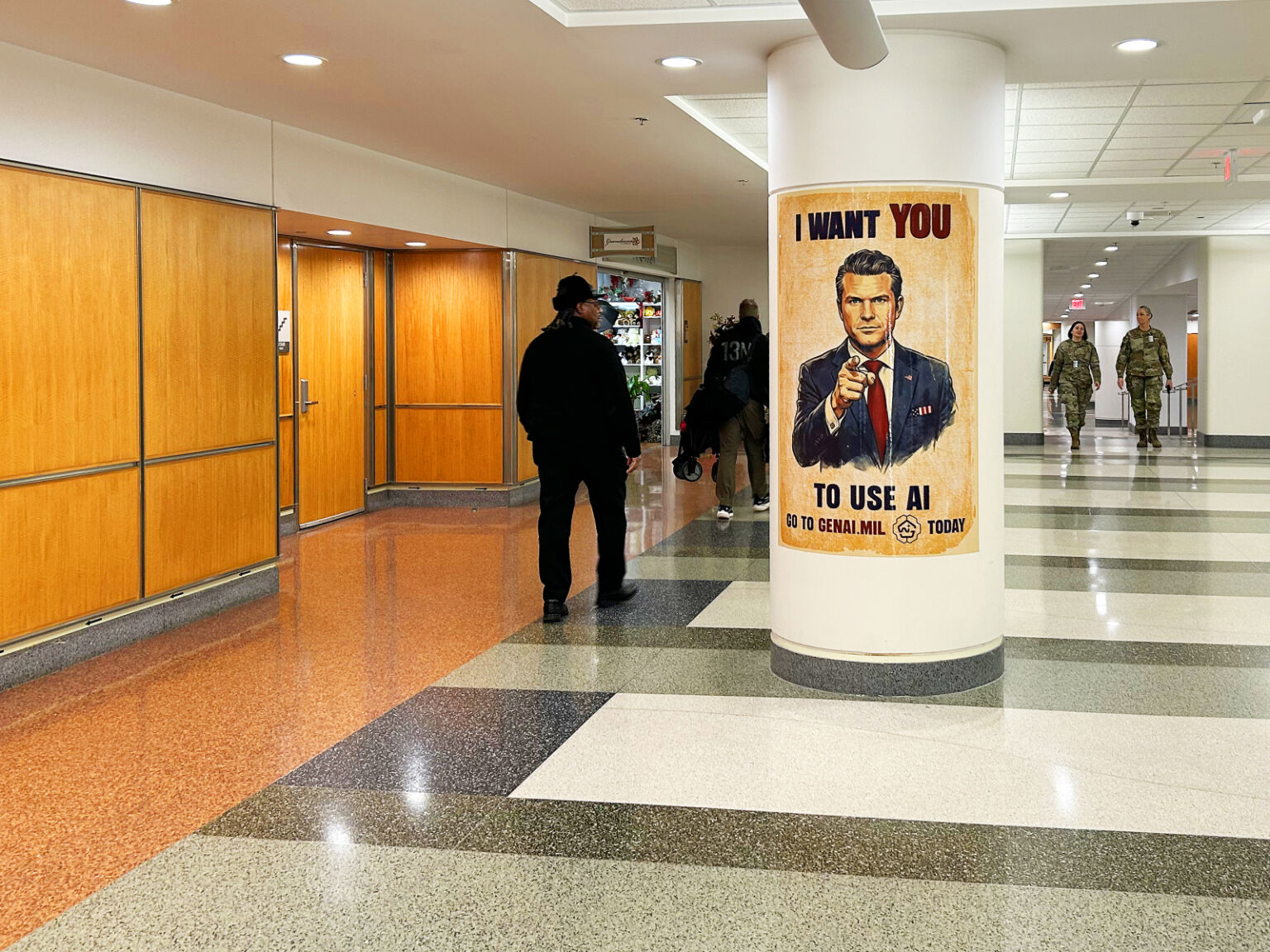
GenAI.mil: Providing Department-wide access to
frontier generative AI models, like Google's Gemini and xAI's Grok, for
all DoW personnel at Impact Level (IL-5) and above classification
levels.
Enterprise Agents: Building the playbook for rapid and secure AI agent development and deployment to transform enterprise workflows.
This AI Acceleration Strategy is driving a major expansion of AI
compute infrastructure through targeted investments and will unlock
access to the data that gives the War Department an asymmetric edge. The
Department will bring in top American AI talent through initiatives
like the Office of Personnel Management's "Tech Force" initiative and
will empower small, accountable teams to attack complex AI integration
opportunities. The War Department will eradicate woke DEI from our AI
capabilities and ensure our military has objective, mission‑first
systems that will guarantee decision superiority and warfighting
advantage in this AI era.
An assymmetric edge, free of woke. A few good men and all that. A promise for a War Department future, where DOD is as yesterday as vinyl records. And no woke, in case you missed that. Testosterone rules, Hegseth on down.
An important paragraph at the end -
"Speed defines victory in the AI era, and the War Department will
match the velocity of America's AI industry," said Emil Michael, Under
Secretary of War for Research and Engineering. "We're pulling in the
best talent, the most cutting‑edge technology, and embedding the top
frontier AI models into the workforce — all at a rapid wartime pace."
Speed. When NFL quarterbacks are evaluated, a quick release matters, but accuracy matters more. As in don't target a girls school, in the "warfighter" context.
Grounded in the core tenets of warfighting, intelligence and
enterprise operations – and following President Trump's direction – the
War Department will accelerate America's Military AI Dominance by
becoming an AI-first warfighting force across all domains.
GAMBIT SERIES - Hoo Rah. And Anthropic wants a guardrail upon the hallucinating tendency of AI when done via LLM deep neural nets which can from time to time show up. Reliability worry. Girls school and all that. Targeting faster than human oversight can oversee. The new War Department.
We have the strength and power to do it alone, but not exactly.
The boat goes faster the more oars being pulled? What?
AI, drones, and advanced sensors have changed the tempo of modern
warfare. Yet acquisition cycles, certification timelines, and training
pipelines still operate at industrial-era speed.
AI — particularly at the edge in denied, disrupted, intermittent, and
limited environments — is now central to operational resilience and
real-time decision-making.
But most programs continue to struggle with time-to-deployment. On
the battlefield, “almost ready” is indistinguishable from not ready.
Marginal performance gains rarely change outcomes if the model
arrives too late, cannot adapt to changing conditions, or fails on
deployed hardware. A 1 percent accuracy improvement does not compensate
for a six-month update cycle.
US
Army soldiers inspect a small counter-drone system during Project
Flytrap 4.5 testing in Germany. Photo: Staff Sgt. Yesenia Cadavid/DVIDS
Stalling Between Prototype and Deployment
Most AI failures are not caused by a lack of ideas. They occur in the
transition from promising demo to operational system, where
experimentation meets doctrine, acquisition, and real-world constraints.
A few failure patterns appear repeatedly.
Linear development processes are applied to adaptive systems.
Sequential handoffs slow iteration and blunt the feedback loop from
operators.
Validation cycles are misaligned with operational tempo. Lengthy review timelines conflict with rapidly evolving mission needs.
Compliance frameworks built for static software struggle with
continuously evolving models. One-time certification does not fit
systems that must update frequently to remain relevant.
Technical barriers compound the issue. Hardware diversity across
platforms forces re-optimization and re-engineering. Models tuned for
one compute environment often fail to translate to another. Fragile
lab-to-field pipelines rely on manual integration and bespoke
configurations, slowing repeatability and scale.
Operational fragmentation is equally limiting. Developers, operators,
and acquisition teams operate under different incentives and timelines.
No single authority is accountable for time-to-field. Past program
failures reinforce risk aversion, encouraging extended experimentation
over operational commitment.
The result is predictable: pilots proliferate, deployments stall.
Compressing AI Deployment Timelines
Reducing deployment time requires treating fielding as a primary design requirement, not a downstream phase.
Portability across compute environments must be engineered from the
start, enabling models to run across edge, tactical, and centralized
systems without extensive rework.
Leaders must also embrace simplicity as a design principle. Fewer
dependencies reduce integration time, while predictable behavior
accelerates trust and adoption.
Development, testing, and deployment must function as a continuous
lifecycle. Automated pipelines replace manual integration. Models are
built with field constraints in mind, and transition planning begins
early rather than after a successful demo.
Governance must evolve as well. Static certification models should
shift toward lifecycle oversight — monitoring performance, risk, and
reliability continuously. Controls adjust based on operational context
rather than blocking iteration outright.
Critically, time-to-deployment should become a formal performance
metric alongside technical accuracy and cost. Programs should be
evaluated not only on what they build, but how quickly it reaches
operators.
AI must be considered an iterative process, setting a minimum
threshold to field it and iterate with field data to deliver the best
value.
Conceptual illustration of AI in the military. Photo: US Mission OSCE
Speed as Capability: Implications for Defense Leaders
The strategic consequence of slow AI deployment is straightforward: advantage shifts elsewhere.
In prolonged competition, the force that iterates faster shapes the
operational environment. Resilience depends on the ability to deploy,
update, and iterate continuously, not just to build once.
The next phase of military AI adoption requires two shifts.
First, move from experimentation to execution. Fewer isolated pilots,
more deployable capabilities, and clear transition paths to operational
use.
Second, embed speed into requirements and oversight. Delivery
velocity must be treated as mission-critical, not as a secondary
efficiency metric.
A recent US Navy implementation supporting Project AMMO illustrates the impact.
By restructuring the model update pipeline and reducing manual
integration steps, the time required to update an AI model dropped from
six months to a matter of days — a 97 percent reduction. That change did
not improve accuracy by a fraction of a percent. It changed how quickly
capability could adapt in the field.
Time-to-deployment is no longer a supporting concern. It shapes readiness, resilience, and deterrence.
In AI-enabled defense, velocity is strategy. The force that deploys first — and adapts fastest — holds the advantage.
Jags Kandasamy is CEO and Co-Founder of Latent AI.
Phrased otherwise, fuck you Anthropic, take your Claude and shove it, it's risk tainted, we say so, but wait a bit for us to find some other vendor with less inclination toward guardrails who can still interface with Palantir - our way. The only way.
(Ignore for now that nasty little massive domestic surrveilance qualifier, look elsewhere.)
Something like that, and for now Claude/Maven is being war tested, (the only test - warfigfhters fighting a war) so wait a bit to shove your Claude, okay?
That image is from here. Now we can speculate, from mid-item - about getting their minds right:
Google’s press release on the day of the Pentagon’s announcement said
that its model is designed to supply the DOD workforce with “an edge”
through natural language conversation and retrieval-augmented
generation.
RAG refers to a technique that essentially makes chatbots and other
models more reliable, by enabling them to look up information from a
specific set of relevant data sources before answering a question.
Prior Defense Department-supplied AI options rely on RAG datasets
that are created locally, or specifically shared with individual users
or user groups. This approach works well, according to a defense
official, because it allows people to deliberately curate datasets that
contain accurate information tailored to their specific purposes.
The official suggested that Google’s offering in the platform has an
internal dataset that appears to consist of cached, scraped web content
that is enabled by default. Google reportedly places citation markers
next to content pulled.
“So functionally, Google has effectively included an internal dataset
that — unless explicitly disabled — draws from web-based data sources.
The upshot, your ragheads should only rely on officially generated RAG? What? Or, don't call them ragheads, since they may regard that as an un-woke usage?
Call them warfighters, even at the remf jobs? (If remf is still an employed usage?)